Understanding Condition & Grading
Condition is the single biggest factor in what your stickers are worth. Here's a plain-language guide to how it works.
The Reality Check
Most collections from this era were handled by kids, stored in shoeboxes, and shuffled around for decades. That's normal. But here's the thing that makes Wacky Packages different from, say, baseball cards: by the late 1980s and 1990s, people had started treating sports cards with care — sleeves, top loaders, binder pages. Wacky Packages almost never got that treatment. They were novelty stickers. Kids stuck them on lunchboxes, school binders, and bedroom doors. They were traded on playgrounds, shoved in pockets, and rubber-banded together. The people who owned them usually weren't collectors — they were just kids having fun.
That means most surviving Wacky Packages show real wear. That's normal, and it doesn't mean they're worthless. Condition affects value, but rarity matters too — a beat-up 1973 OPC card that almost nobody has is still worth something. The key is understanding what you're looking at.
Before You Start: OPC Was a Candy Company (click to expand)
To understand why OPC cards look the way they do, you need to know what kind of company made them. O-Pee-Chee was founded in 1911 in London, Ontario as a chewing gum manufacturer. Trading cards came along in the 1930s as a promotional novelty — something to tuck into gum packs to boost sales during the Depression. For most of OPC's history, the Adelaide Street plant was primarily a candy and gum operation. Cards weren't OPC's core business — they were a side line attached to a sweets factory.
This isn't a guess. A former press operator who worked on the OPC card line starting in 1972 put it bluntly when collectors asked him about quality control: "C'mon — this was a candy/bubblegum manufacturer!" He also mentioned that cards weren't considered a big deal at the time, and that many employees took home uncut sheets. The Adelaide Street workers were good at making chewing gum. They made cards on the side, with the same equipment culture and the same priorities.
That mindset shows up in three things you'll notice on OPC Wacky Packages: loose centring, sticker die-cuts that don't always sit where they should, and the occasional production error. None of these are damage. They're the fingerprints of how the cards were made.
Centring & Sheet Misalignment
This is the dominant quirk on OPC Wacky cards. Most vintage cards from any company are at least slightly off-centre — that's normal for the era — but OPC Wackies are noticeably looser than their American Topps counterparts. You'll see uneven white borders, the black package outline clipped on one side, the copyright line shifted out of position, and on more dramatic examples, fragments of text from a neighbouring card bleeding in along one edge.
Here's why. OPC cards weren't actually printed at OPC. They were printed by Lawson and Jones, a commercial printer on Wellington Road South in London, then shipped to OPC's Adelaide Street facility for cutting and packaging. At Adelaide Street, the slitter had multiple circular blades spinning on a shaft — a printed sheet would be hand-fed under them and emerge as strips of cards in a single pass. (For decades collectors believed OPC used wires to cut the cards. Two firsthand sources — a former press operator and a researcher who interviewed OPC's longtime owner Gary Koreen — agree it's a myth. There were no wires. It was the same general type of slitter Topps used.)
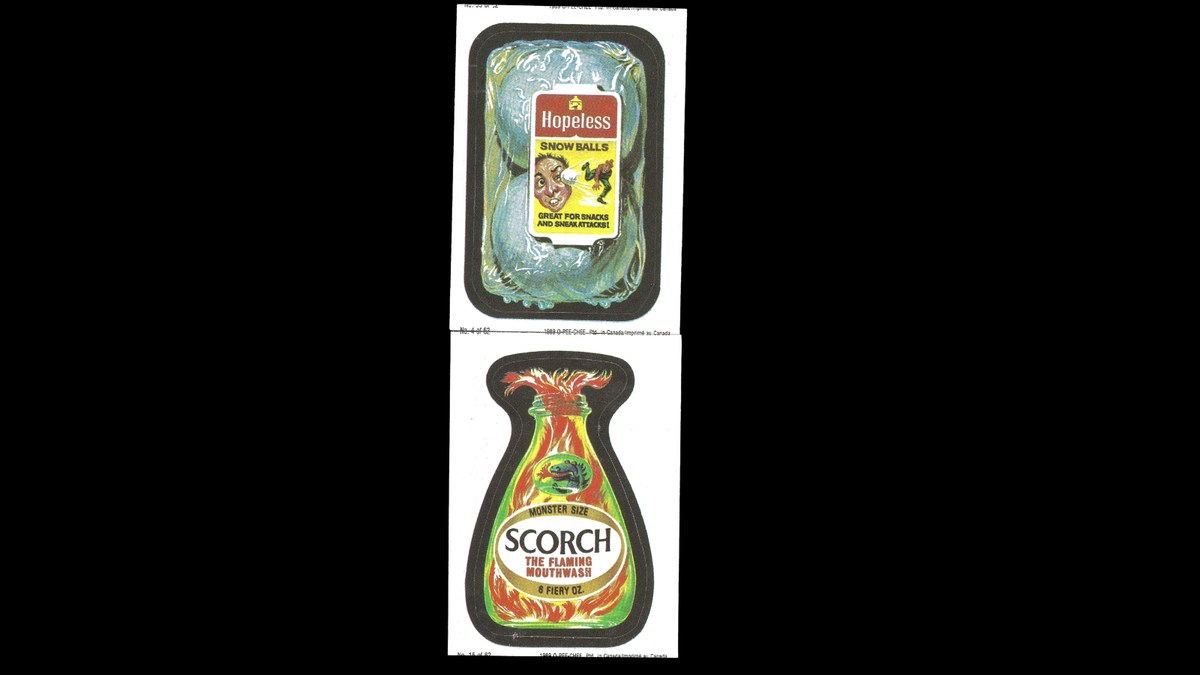
The problem wasn't the equipment. It was that nobody was checking precisely where the cut landed on the sheet. When the slitter blades came down in the wrong horizontal position, the strip of cards that came out had parts of the adjacent rows visible along the top or bottom edge. That's why you'll often see fragments of text — sometimes a thin strip of the next card's image entirely — running along the top or bottom of a Wacky card. It's the card above or below on the sheet, sliced off when the slitter went through. You can see the slitter mechanism made visible when two adjacent cards from the same column on a sheet are placed together: the cut line runs straight across, and the printer's marginal text from the bottom of one card meets the top of the next right along that line.
Front and Back Don't Always Agree
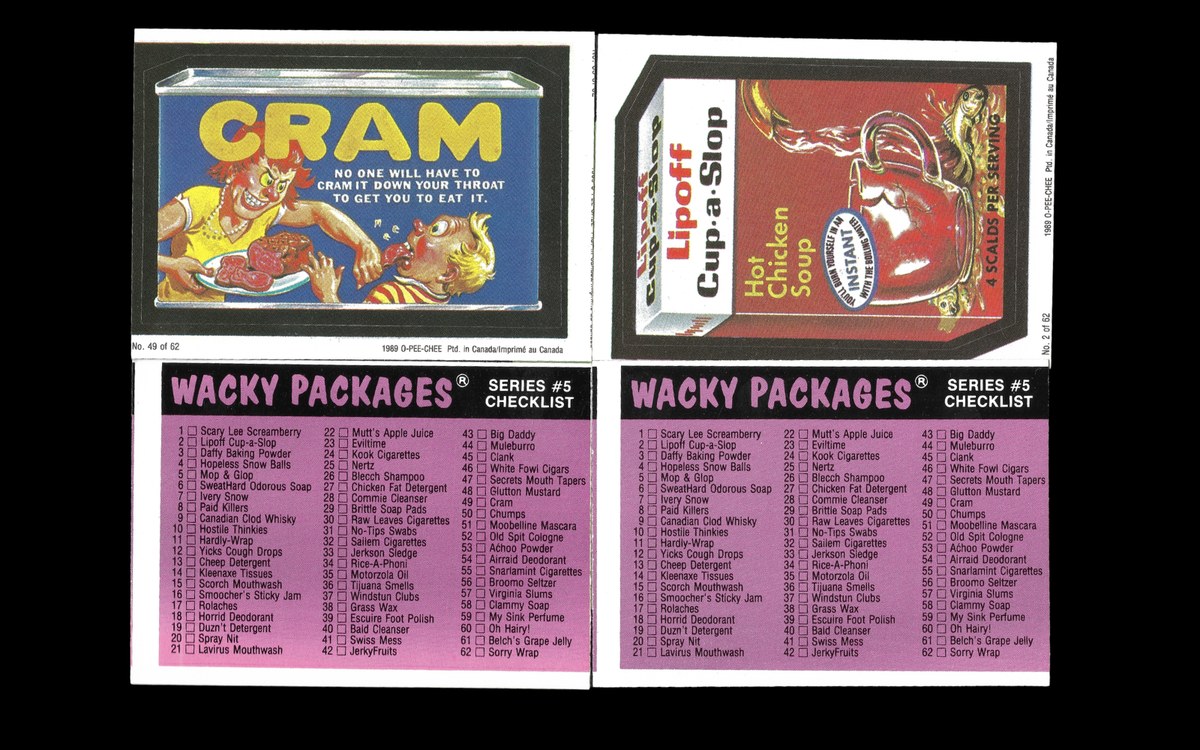
Because the front and back of each card were printed in separate passes, the two sides don't always agree with each other. You can have a card where the front looks reasonably well-centred and the back is dramatically off — checklist text shoved into one corner, or puzzle artwork sliding off one edge. It's most obvious on the checklist backs, where the grid structure makes any misalignment instantly visible: a checklist with one column touching the edge and a wide blank space on the other side is the diagnostic. Puzzle backs have the same problem, but it's harder to spot on a single card — you only really notice when you try to assemble multiple cards into the full puzzle and the pieces don't tile cleanly. Professional graders check both sides of every card. If you're sending photos for appraisal, photographing front and back is helpful for the same reason.
Sticker Position on the Card
Wacky Packages have an extra production step that hockey and baseball cards don't: each card is also a sticker, with a die-cut outline pressed into the cardstock so the front can be peeled off and stuck somewhere. The sticker artwork and its die-cut outline are properly aligned with each other — that part of the production was reliable. What's often wrong is where that whole sticker assembly sits on the cardstock.
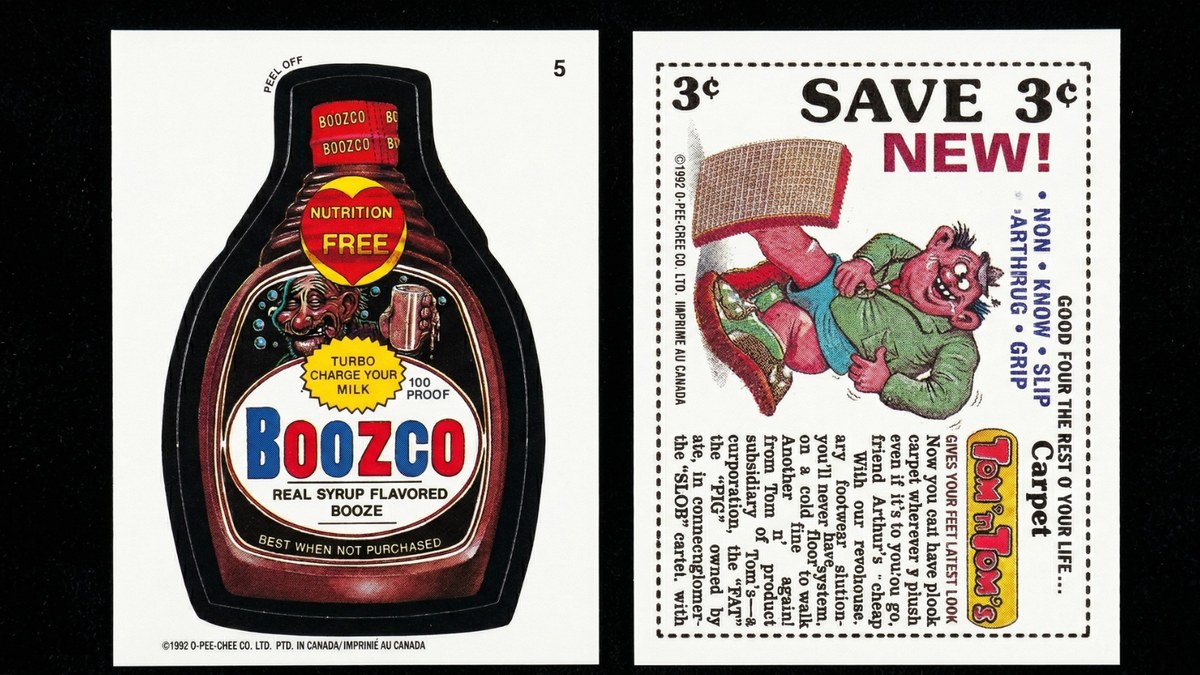
You'll see Wackies where the sticker is shoved against one edge of the card with a huge white border on the opposite side, or shifted so far that the die-cut almost runs off the cardstock entirely. The sticker itself is fine. The card around it isn't.
This is something to look for specifically when you're going through OPC Wackies. A card with clean centring AND a well-positioned sticker is genuinely uncommon — not because the cards were destroyed over the years, but because they were rarely manufactured cleanly in the first place.
Misprints & Production Errors
Beyond the everyday centring and die-cut issues, OPC cards sometimes had more dramatic production errors. The OPC press ran four colour plates in order — yellow, magenta, black, and cyan — and if any one of them was even slightly out of register, you'd get a blurry image, a "shadow" effect, or a missing colour layer. Sometimes a small dimple in a plate would print a tiny dot on every card from that run; at a candy plant, that wasn't important enough to stop production and fix.
True error cards — blank backs, wrong backs, missing colour passes, blank fronts — are rare and they're a niche corner of the hobby. Some collectors actively seek them out. If you have one, it's worth mentioning in your appraisal.
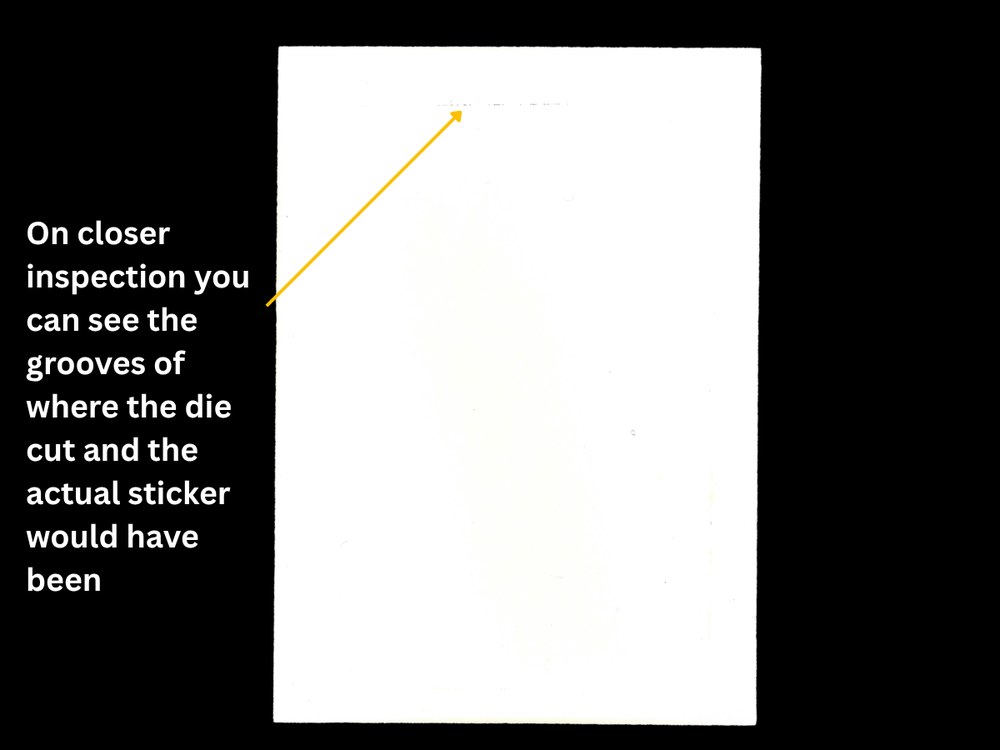
I have an OPC Wacky card with a completely blank front — no print, no sticker die-cut, no artwork. Just raw white cardstock where the sticker should have been. I pulled it pack-fresh myself from a 1989 OPC wax pack, so I can vouch for the provenance.
This kind of card is rare — you won't find one in most collections. But it's a good illustration of how casually the production line was monitored. A sheet that should never have been packaged was packaged, and nobody caught it before it left the building. If a true blank-front card can make it into a sealed pack, it tells you something about what got past the line on a routine day.
What About Rough Edges?
If you've read about OPC cards on hockey forums, you've probably seen the famous complaint about "rough cuts" — ragged, fibrous edges from dull slitter blades being pushed past their useful life. It's a real OPC trait and the story behind it is well documented (operators at Adelaide Street were paid bonuses on volume, and sharpening blades meant downtime). On Wacky Packages specifically, though, it barely shows up. A review of about 1,200 OPC Wacky cards turned up few if any examples of true rough cuts. The cardstock and the production approach for stickers seem to have produced cleaner edges than the heavier hockey cardstock did. Mention it if you see it, but don't expect it on most Wackies.
Beyond manufacturing itself, OPC's packaging decisions also affect how Wacky cards look today. From 1973 through 1989, every OPC Wacky pack came with a stick of bubble gum inside the wax wrapper, which produces its own set of condition characteristics. See Gum Stains & Wax Residue below for the details.
Looking to tell whether a card is OPC or Topps in the first place? See the Identification Guide.
Condition Grades (click to expand)
Here's what each condition grade means in plain language, along with what to look for on your cards.
Note about the graded images
The four condition examples below are AI-edited, and I want to be upfront about how and why. I started with scans of real OPC Wackies I'd just pulled from packs — even pack-fresh, they sat at around EX+ rather than true NM, which is part of the OPC story this page is about. From there I used AI to walk one card up to a clean NM example and back down through EX, VG, and Below VG, so all four grades show the same card and you can compare them directly.
I went this route for two reasons. The first is that I wasn't willing to damage real cards just to demonstrate what heavy wear looks like. The second is consistency — using the same card across all four grades means the only thing changing between images is the condition, which makes the comparison much more useful than four different cards in four different states would be.
The wear patterns are based on what real OPC Wackies actually look like at each grade — soft corners, creases, age toning, the things that fifty years in a drawer does to a sticker. If you'd rather see real worn cards, every appraisal report I send out includes condition assessments based on actual photos of your collection.
Like New NM — Near Mint
Looks like it just came out of the pack, and almost nothing does. Sharp corners on all four (turn the card under a lamp and check each one — soft corners catch the light differently than sharp ones). No creases anywhere on the front or back (creases hide in flat overhead light — tilt the card slightly and they show up as lines). Colours are bright and haven't drifted toward yellow. The back is clean — no gum residue, no staining, no marks where a wrapper sat against it. Centring is reasonable.
For OPC specifically, even a true NM card usually has slight centring drift or a die-cut that doesn't sit perfectly on the cardstock. That's the manufacturing ceiling from the section above — it's not a defect, it's just how OPC made them. NM is genuinely rare for Wacky Packages and almost unheard of for the 1973 sets.
Good Shape EX — Excellent
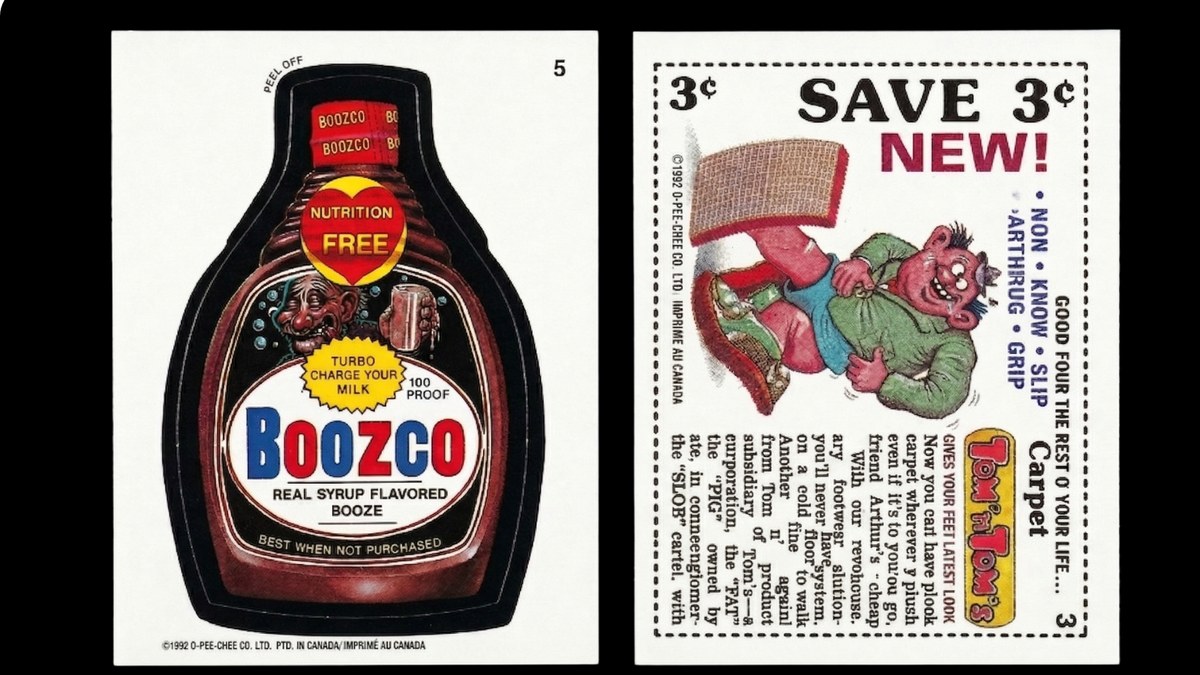
Minor wear from age, but still clean and presentable. Maybe one or two corners have softened slightly. The surface might have a faint mark or a tiny scuff that you only see when you tilt the card. The back is mostly clean — possibly a faint trace of wax sheen from the original wrapper, but no real staining. No creases. Colours are still strong.
This is what a careful collector's card looks like fifty years later. It's also where a lot of pack-fresh OPC Wackies actually land, because the manufacturing quirks (off-centring, die-cut drift) keep them out of true NM territory even when the handling has been perfect. EX is a strong grade for any OPC card, and the working ceiling for most well-preserved late-80s and 90s sets.
Worn VG — Very Good
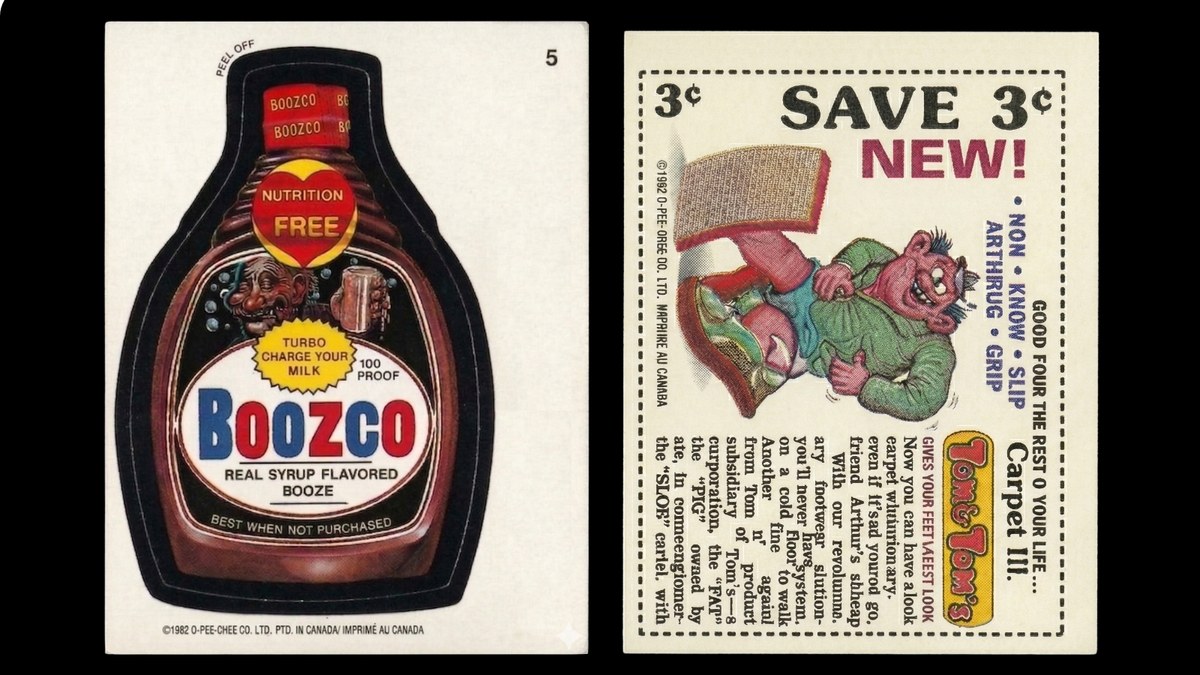
Obvious handling. Corners are noticeably rounded. There may be one or two light creases visible when you tilt the card. The surface has scuffs or small marks. The back often shows gum staining — light to moderate brown discolouration where the wrapper's gum sat against the card for years — and there may be wax residue on the front or back, visible as a slight greasy patch when you tilt the card under light. Centring may be noticeably off. Colours are still readable but may have softened.
This is where most surviving OPC Wackies actually land, especially anything from the 1970s and early 1980s. These were stickers that lived in shoeboxes with their friends, often still wrapped around bits of gum and wax paper — a clean back is the exception, not the rule. A VG card is not damaged, it's normal.
Rough Below VG
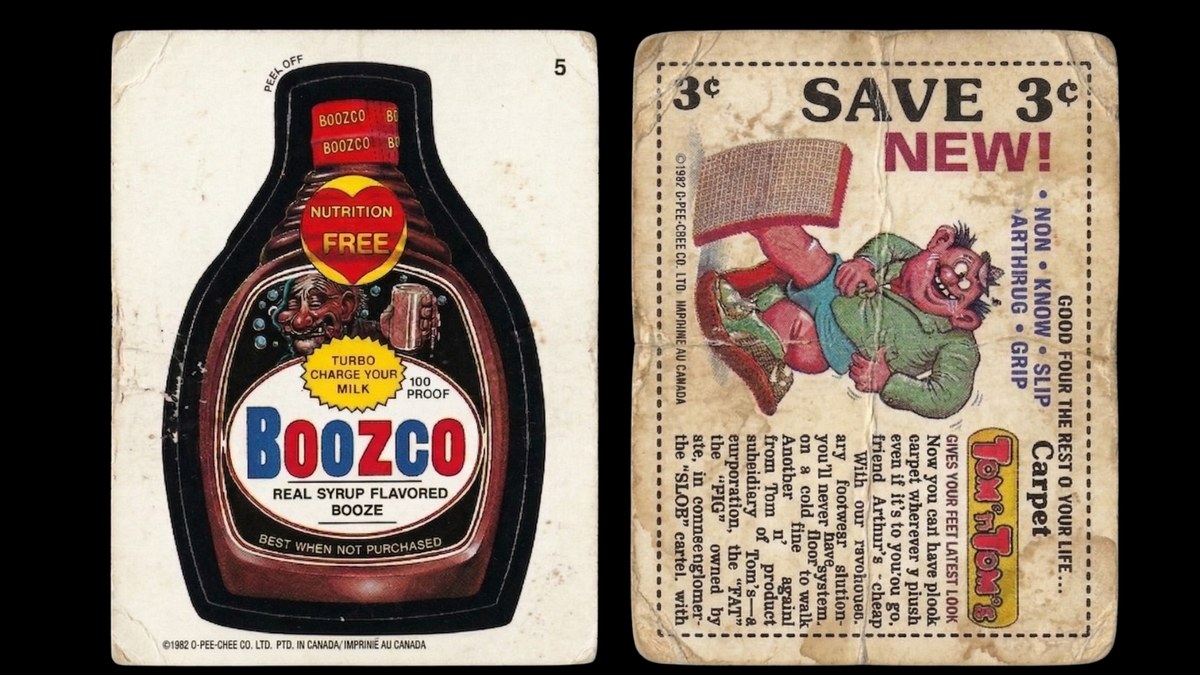
Heavy damage. Major creases that go all the way across the card. Corners are rounded down to soft nubs or have small chips missing. The surface may have writing, tape residue, or torn areas. The back often shows dark gum staining that's worked into the paper, and you may see gum tears — places where hardened gum stuck to the card and pulled paper fibres away when it was removed, leaving rough or missing patches. Some cards have hardened gum still attached. Heavy wax residue is common.
Maybe it was peeled and re-stuck. Maybe it spent a summer in a back pocket. Maybe a brick of gum welded itself to the front in 1979 and nobody dared remove it. These cards still have value if the title is rare, and a beat-up version of a hard-to-find card is worth more than a clean version of a common one. Don't throw anything out before getting it looked at.
Real cards don't always land cleanly on one of the four grades above. A card can sit between EX and NM — better than typical EX, not quite clean enough for NM — and that's what a grade like EX+ captures. The same applies at every level: VG+ means a card that's solidly worn but stronger than a typical VG, edging toward EX territory.
Grading isn't an exact science. Two careful graders can look at the same card and land one notch apart, and a card that grades EX today might grade EX+ in the right light tomorrow. What I try to do across every appraisal is be consistent — apply the same standards to every card I look at, lean conservative when in doubt, and explain my reasoning when a grade is borderline. You'll see plus grades and "between" descriptions in your appraisal report when they fit.
Wacky Packages weren't preserved like baseball cards. They were stickers — most of them got peeled and stuck on things, or thrown in a drawer with their friends. Cards that survived in great shape are the exception, not the rule.
Two things shape the realistic ceiling for OPC Wackies. The first is simple time and supply: a 1992 card has had thirty years to get damaged, while a 1973 card has had over fifty. There are also more late-80s and early-90s cards still around in any given condition, and by the mid-80s card collecting had become a recognized hobby, so a higher share of buyers were treating their cards carefully from the start. Newer OPC tends to show up in better shape just because newer cards always do.
The second force pulls the other way. OPC's manufacturing didn't improve over the years. The same loose centring, the same wandering die-cuts, the same candy-plant quality control that produced the 1973 sets was still producing the 1992 set. A 1992 OPC Wacky can have sharp corners and zero handling wear and still not grade NM, because the sticker sits crooked on the cardstock and there's nothing the original owner could have done about it.
Here's what's realistic, by era:
- 1989 and 1992, well-kept, usually grades EX. These cards were less likely to be peeled and more likely to survive intact, but OPC's manufacturing keeps a hard ceiling on how high they can go. NM exists but it's uncommon, and EX is the working top for most well-preserved late OPC.
- 1985 through 1988, well-kept, typically lands at EX or VG+. The transition era — newer than the 70s sets but with fewer pristine survivors than 1989 or 1992.
- 1973 through 1982, even when carefully kept, mostly grades VG to VG+. An EX example from this era is genuinely uncommon and worth flagging.
These are general patterns, not rules — you'll see exceptions in both directions.
None of this is a problem for value. Most OPC Wackies trade in these grades — that's the realistic market, not a discount from some imaginary perfect version. If your cards land at VG or EX, that's normal. If you have something that grades higher than its era usually allows, that's a card worth paying special attention to.
Gum Stains & Wax Residue
If your cards came from original packs, there's a good chance at least a few have a yellowish-brown mark, a faint waxy patch, or some kind of oily residue on one side. This is the single most common condition issue on vintage OPC Wacky Packages. It's real damage — graders factor it in and it does affect what a card is worth — but it's also damage that came with the product, not something you or anyone else did wrong.
Why Almost Every OPC Wacky Has Gum or Wax Marks
From 1973 through 1989, every OPC Wacky Packages pack came with a stick of bubble gum sealed inside a wax wrapper alongside the cards. Two release years are exceptions:
- 1982 — the album-sticker set was a different product entirely. Printed in Italy in the European sticker-album format, it shipped as a pure sticker product with no gum.
- 1992 — OPC's final Wacky release. By this point the trading card industry was phasing gum out of packs entirely. Topps had removed gum from their baseball packs in 1991, citing collector concerns about gum-stained cards damaging value, and OPC followed suit for the 1992 Wacky release. Sports Illustrated put it bluntly in 2000: gum stains devalue the cards.
For the other nine OPC Wacky release years — 1973 (all four series), 1979/80 reruns, 1985, 1987, 1988, and 1989 — your cards spent their pre-pack life pressed up against a stick of gum and a wax wrapper.
An important point about timing: these marks aren't just an aging issue. Anyone who opened a pack as a kid in the 1970s or 1980s remembers cards coming out with faint waxy patches and gum impressions — they were there from day one. Gum stains specifically, though, can get worse over time. The sugars and oils in the gum continue migrating into the cardstock for years, so a pack that sat sealed for forty or fifty years before being opened can have deeper, darker, more set-in gum stains than the same cards would have shown a year after they were made. Wax residue is mostly a day-one transfer; gum staining is a slow chemistry experiment that's still going.
What to Look For
Here's the key thing to understand about how this damage happens. In any wax pack — whether it's four cards or eight — there are two positions in the stack where damage is essentially built in. One card sits against the gum stick and takes the gum staining (and sometimes hardened residue or gum tears). One card sits against the wax seal of the wrapper and takes the wax film. The cards sandwiched in between those two positions are usually fine, unless the pack was stored badly, exposed to heat, or crushed at some point.
That's why on a typical pack you'll find the same pattern: two cards with real, visible damage from gum and wax contact, and the rest of the cards looking comparatively clean. It's not random and it's not avoidable — it's just how the product was assembled.
The four sections below cover what each type of mark actually looks like.
Wax Stains and Wax Residue
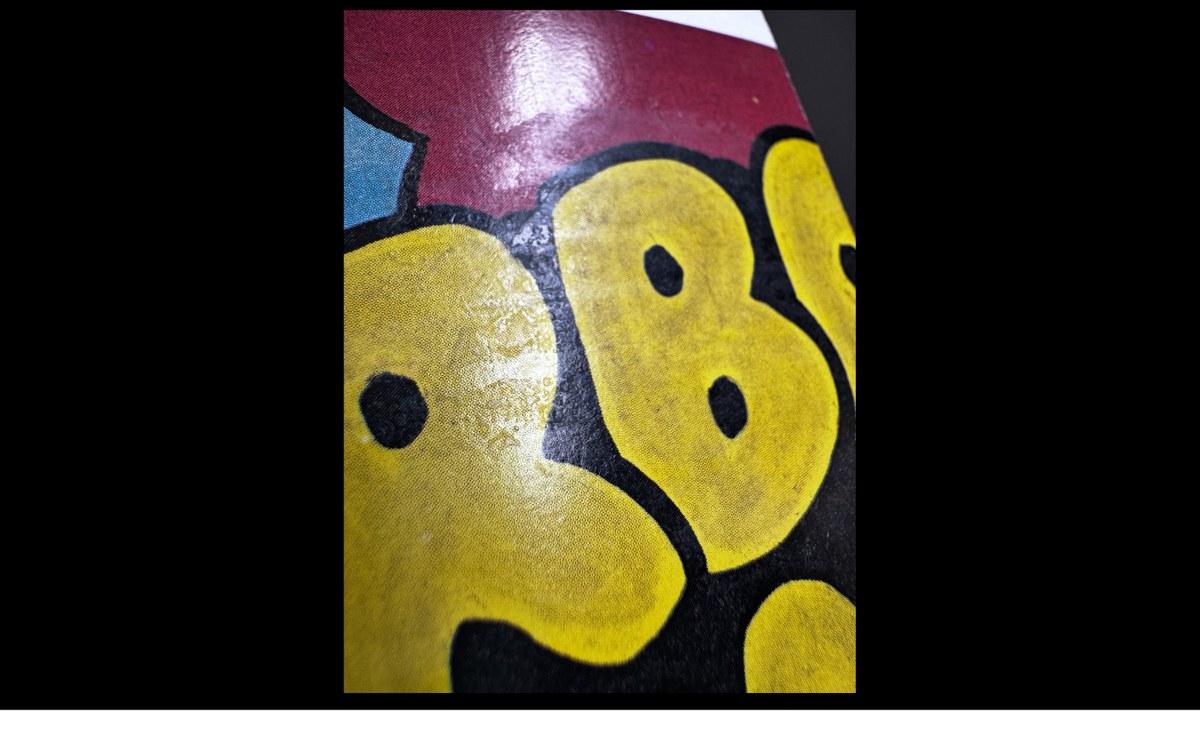
Wax from the wrapper transferred onto the cards as soon as they were packaged. The result is a faint, slightly translucent patch — often hard to see straight on. The trick to spotting wax residue is to hold the card under a light and tilt it. A wax patch that's invisible head-on will catch the light at an angle and become obvious. Cards from the top or bottom of a pack are usually the worst affected because they were directly against the wrapper.
Gum Stains on the Back
The classic OPC condition issue. Gum sat against the back of one of the cards in the pack, and over time the sugars and oils in the gum migrated into the cardstock. The result is a brownish or yellowish discolouration, usually in roughly the shape of the gum stick, often near the centre of the card back. It's real damage — it does lower the grade a card can receive — but it's also damage that nobody could have prevented. The gum was inside the wrapper from the day the pack was sealed at the factory.
Gum Residue and Stuck Gum
Sometimes the gum didn't just stain — it physically bonded to the card. You can find OPC Wackies with hardened gum still attached, or with pitted areas where gum was once stuck and pulled paper fibres away when removed. Older packs are more likely to have this problem because there's been more time for the gum to harden and the bond to set.
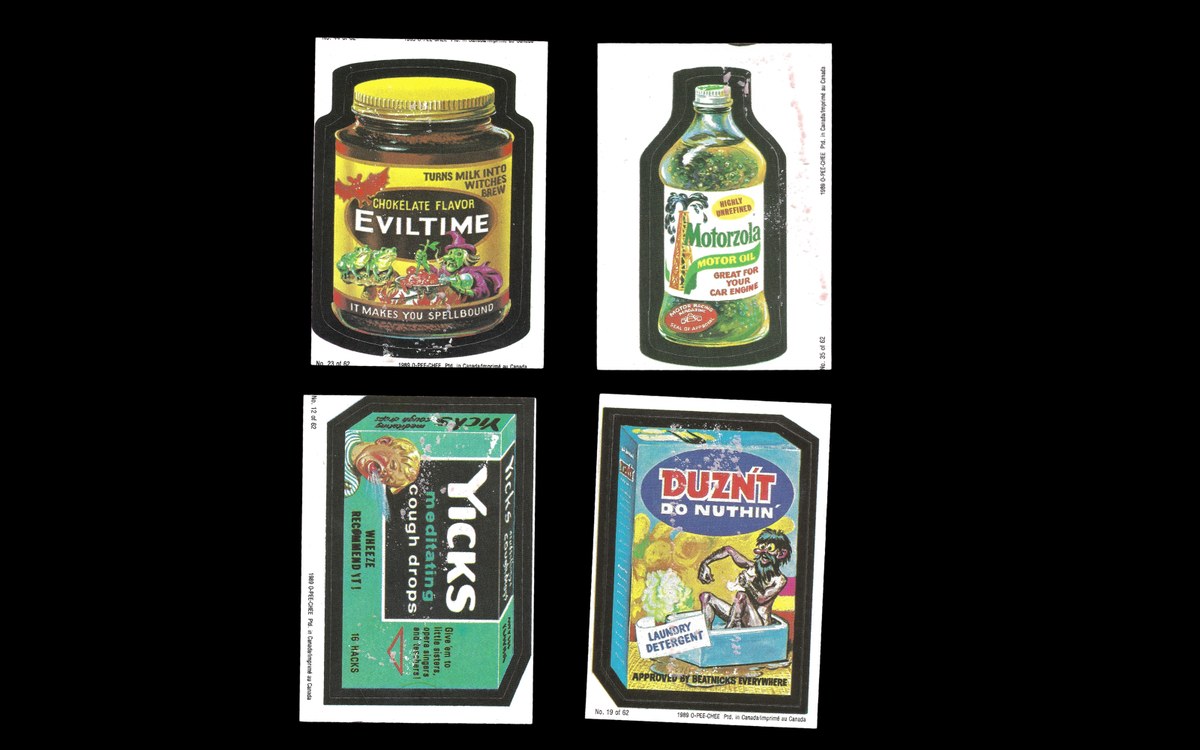
Gum Tears
The worst-case scenario. When gum was strongly bonded to a card and someone tried to separate them, the cardstock sometimes tore — leaving a clean rip on the card back where the gum had been. These cards aren't fakes or damage from handling; they're cards that lost a fight with hardened gum decades after being packaged.
A Few Practical Rules
- This is real damage, but it's not your fault. Gum and wax marks lower the grade and reduce what a buyer will pay. They are condition defects, full stop. The thing they're not is anything the original owner could have prevented — they came with the pack, sealed at the factory.
- Don't try to clean them. Rubbing, scraping, or using solvents will almost always make things worse. Leave the card as-is — collectors and graders prefer untouched.
- Severity matters. A faint wax patch is minor. A heavy gum stain that shows through to the front, hardened residue, or a gum tear is significant. Professional graders factor all of it into the grade.
- Rare cards still have value with damage. A gum-stained 1973 OPC card is still a 1973 OPC card. For scarce titles, collectors will happily buy stained copies — the rarity outweighs the surface issue.
- A pristine vintage OPC card has to survive two lotteries — manufacturing and packaging. The press run had to land the cut and the die-cut in the right places. The pack had to put your card somewhere other than the gum and wax positions. Both have to go right. Truly pristine OPC cards are uncommon for a reason — the system was working against them from the start.
Professional Grading (Slabs) (click to expand)
Professional grading means sending your card to a company that authenticates it, assigns a numeric grade, and seals it in a tamper-proof plastic case called a "slab." Graded cards often sell for more than ungraded ones because the buyer doesn't have to guess about condition.
Major Grading Companies
| Company | Scale | Notes |
|---|---|---|
| PSA | 1–10 | The most widely recognised grading service. Most Wacky Packages slabs you'll encounter are PSA. |
| CGC | 1–10 | Originally known for comics, now grades trading cards too. Same numeric scale. |
| SGC | 1–10 | Respected in the vintage card market. Same scale, different market perception. |
| KSA | 1–10 | A Canadian grading company. Less common but legitimate. |
What the Numbers Mean
Here's a rough mapping between the plain-language grades and numeric grading scales:
| Numeric Grade | Roughly Equivalent To |
|---|---|
| PSA 8–10 | Like New (NM or better) |
| PSA 7 | Good Shape (EX/NM) |
| PSA 5–6 | Worn (VG) |
| PSA 1–4 | Rough (Below VG) |
Should You Get Your Cards Graded?
Probably not — unless you have a genuinely rare card in exceptional condition. Grading costs money (typically $20–50+ per card) and takes weeks. For most collections from this era, the grading cost would exceed the increase in value. If you think you have something special, mention it in your appraisal request and I'll let you know whether grading makes sense.
If you ever see someone advertising a "Near Mint complete set" of OPC Wacky Packages — from any year of the run, 1973 through 1992 — be skeptical. The combination of OPC's loose manufacturing (off-centring, wandering die-cuts, off-register printing) and the gum/wax damage built into wax packs means a true NM example of any individual card is uncommon, and assembling a complete set of them is essentially impossible. Even the 1992 set, which shipped without gum, still has the manufacturing issues.
Most "NM sets" you'll see claimed online are mixed-grade sets with the seller using "NM" as a vibe rather than a measurement. If you're buying, ask for individual photos of every card, and don't pay NM prices for cards that haven't been individually examined. The hunt for a truly pristine OPC set is part of what makes this corner of the hobby fun — but it's a near-impossible project, and anyone claiming they've finished it deserves a second look.
Sealed Product (click to expand)
Unopened packs, boxes, and sealed wrappers are in a category of their own. They're not graded on the same scale as individual stickers — their value comes from being unopened. Sealed product is always interesting to collectors because of the mystery of what's inside and the scarcity of surviving packs.
If you have unopened packs or boxes, take a photo of the front and back of the wrapper. The wrapper design helps identify the set and era.
Pack Condition — What to Look For
Even though a pack is sealed, its condition still matters. A pristine pack is worth more than a beat-up one. Below is an example of what a well-preserved sealed OPC pack looks like — and four things collectors and graders check for when assessing one.
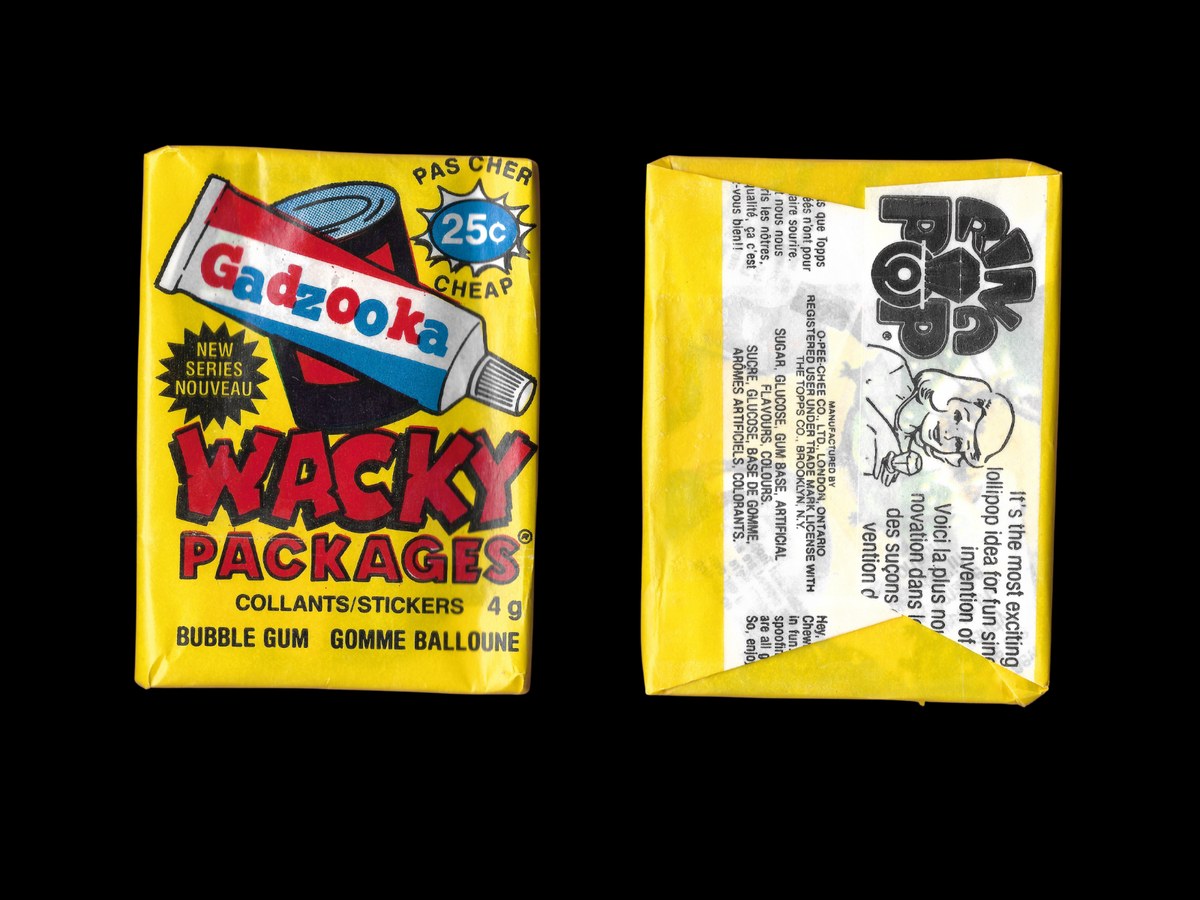
When evaluating a sealed pack, here are the four things to check:
- Wrapper Integrity — Is the wax wrapper fully sealed with no tears, holes, or open flaps? Even a small tear can significantly affect value. Look carefully at the seams and folds — that's where damage usually hides. On the Gadzooka pack above, you can see the back fold cleanly along the centre with no separation.
- Wax & Surface Condition — Wax wrappers can crack, flake, or lose their sheen over time, especially if they've been stored in heat or direct sunlight. A wrapper with bright, intact wax is in better shape than one that's dried out and dull. The pack pictured still has the original colour saturation and surface gloss intact.
- Shape & Pressure Damage — Packs that were at the bottom of a box for decades may be squished, bent, or dented. A pack that's kept its original rectangular shape is more desirable. You can usually feel whether the cards inside are bent through the wrapper. The example pack is square and has held its form.
- Staining & Discolouration — Water damage, age-related yellowing, and staining from other packs can affect the wrapper's appearance. For pre-1992 packs, gum inside the pack can sometimes stain through the wrapper itself. The example pack shows none of this — the yellow is even and bright across both sides, with no brown patches, water marks, or gum bleed-through.
Ready to find out what yours are worth?
I'll assess condition from your photos — you don't need to grade anything yourself.
Request a Free Appraisal