What Your OPC Wacky Packages Are Actually Worth
An honest look at what drives value — and what doesn't — in a small, specific hobby.
Most of what people bring me is worth less than they hope. That's not anyone's fault, and it's not meant to discourage you — it's the honest state of a small hobby. Wacky Packages isn't Pokémon. There aren't millions of collectors bidding against each other. There are a few thousand active collectors worldwide at most, most of them adults with childhood memories of these stickers, and that's the entire demand pool.
This page exists because I'd rather you have realistic expectations going into an appraisal than be disappointed coming out of one. It won't tell you what your specific cards are worth — that's what the free appraisal is for. What it will do is explain the forces that actually set prices in this hobby, clear up some common misconceptions, and help you understand why a collection that looks valuable on the surface might be modestly priced in reality — or occasionally the other way around.
If you're holding Canadian O-Pee-Chee cards from 1973 to 1992, this is written specifically for you. If you're holding American Topps, most of the principles still apply, but the market is different and I'm not the right person to appraise them.
Scarcity alone doesn't make Wacky Packages valuable
This is the single biggest misconception in the hobby, and it runs in the opposite direction people expect.
When someone finds old stickers and starts looking into them, the first thing they usually discover is that some Wacky Packages are rare. Specific cards were printed in smaller quantities. Certain variants are hard to find. Sealed product from 40 years ago is obviously scarcer now than it was then. All of this is true.
What people then assume is that rare equals valuable. It doesn't — not on its own. Price is what happens when scarcity meets demand. In a small hobby, demand is the limiting factor, and plenty of OPC material is genuinely scarce while still being modestly priced, because the pool of collectors actively looking to buy it is small.
Here's an example that helps explain things.
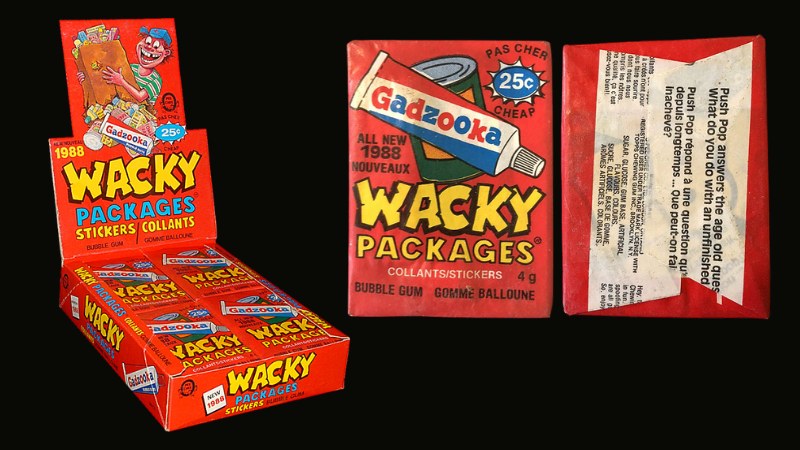
Right now there's a 1988 OPC Wacky Packages sealed box listed on eBay for thousands of dollars. It's a real item, and I'd love to own one — sealed vintage OPC boxes have a collector appeal that goes beyond what's inside them. Scarcity matters, and these boxes are genuinely scarce. You won't find them often.
But look at what's actually in the box. A complete 1988 OPC set — all 66 stickers, not just a pack's worth — trades for something close to the cost of a nice dinner out. Individual singles from the set typically sell for a few dollars each in good shape. A sealed box holds 36 packs of those same stickers.
So the listing asks for thousands. What does it actually sell for? That's the part most people miss: listings like this don't tend to sell. They sit. They get relisted. A new listing appears when an old one expires. The price the seller hopes for and the price a buyer is willing to pay have come apart, and the listing keeps sitting until one side moves.
This is the trap: seeing a four-digit asking price and assuming that's the market. A listing that never sells is just a listing. The market price is what changes hands — and for sealed 1988 OPC product specifically, that number is a lot smaller than the asks suggest, when a sale happens at all.
The principle generalises. Across the hobby, plenty of OPC items are legitimately hard to find and still priced modestly because the active buyer pool for that specific thing is tiny. Rarity without demand is a museum piece, not an investment. Beautiful, historically interesting, sometimes genuinely scarce — but not the windfall people hope for.
The honest question for any sealed pack or box isn't "what's it listed at?" It's "what would I pay to own this forever, knowing I can never open it?" A sealed item is a permanent holding — you can't open it without destroying its value. For most collectors, that number lives much closer to what the contents are worth than to what the listing suggests.
The 1973 1st Series tan vs. white back inversion
This is the single most common thing I see American sellers get wrong on OPC cards, and it comes from a specific inversion between the Topps and OPC versions of the 1973 1st Series.
The 1973 1st Series exists in both a Topps (American) and an OPC (Canadian) version. Both versions have cards with tan backs and cards with white backs. The visible difference is just the colour of the cardboard on the back.
But the rarity is flipped between the two markets.
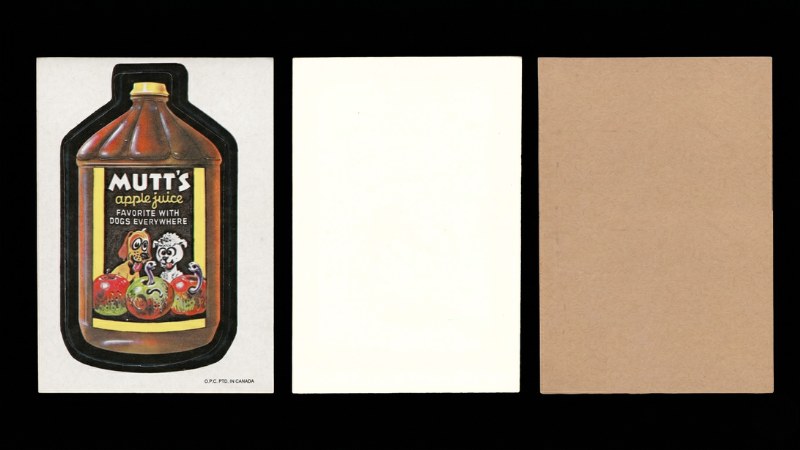
On the Topps 1st Series, tan backs are the scarcer variant — white backs turn up more often.
On the OPC 1st Series, it's the opposite. White backs are the scarcer variant — tan backs turn up more often.
If you know the Topps market well, "tan is scarcer than white" is a rule that holds for American cards and gets applied automatically. Apply that same rule to an OPC 1st Series card and you have it backwards.
This is where I watch US-based sellers miss. They'll price an OPC tan-back 1st Series card as if it were the scarcer variant — because for Topps it would be — when for OPC, tan backs are the ones that turn up more often. Or they'll treat an OPC white-back as the common version and price it low, when for OPC the white back is actually scarcer.
I'm not a Topps expert. I can't tell you with confidence how Topps collectors value their material. But I know OPC, and the 1st Series rarity inversion is the single most frequent mistake I see when American sellers list Canadian cards. If you're trying to value a 1973 OPC 1st Series card by scrolling active listings, a lot of what you're seeing is priced with the wrong rule applied.
1973 OPC 1st Series: white backs are scarcer than tan. The opposite of Topps, where tan backs are the scarcer variant.
If you're not sure which back you have, the identification guide walks through it.
Age doesn't equal value in the OPC market
"It's from 1973" is not, on its own, a reason something is valuable. Neither is "it's from the 1980s." In the Wacky Packages market, specific eras and specific sets command specific values, and age is only one variable.
Here's a rough ordering of how OPC sets actually trade, from most valuable era to least:
| Era | What it is | General value picture |
|---|---|---|
| 1973 Series 1–4 | The Canadian release of the first Topps peel-and-stick Wacky Packages — produced by O-Pee-Chee in bilingual packaging, on distinct cardstock, with different card selections from Topps in 2nd and 4th Series. | The most valuable OPC era. Scarcer than their American cousins and desirable as the first Wacky Packages stickers released in Canada. 2nd Series is the toughest OPC set to complete. Scarce back variants and high-grade examples can command real prices. |
| 1979/80 Rerun | Physically identical to the Topps 1979/80 rerun — same stickers, OPC-only packaging. | Widely available. Modest per-card values. Same catch as 1985: loose stickers can't be told apart from Topps — only a sealed OPC pack proves Canadian provenance, and opening it destroys that provenance. |
| 1982 Album | Smaller-format album stickers, different from Topps. Bilingual packaging. | Harder to find than Topps but modestly valued. Sealed packets turn up occasionally. |
| 1985 | Physically identical to the Topps 1985 release — same stickers, OPC-only packaging. | Widely available. Modest value across the board. The catch: loose 1985 stickers are indistinguishable from Topps — the only way to prove OPC origin is to keep them in a sealed OPC pack. And you shouldn't open the pack to confirm, because the sealed pack itself is where the OPC provenance and any premium live. |
| 1987, 1988, 1989 Reruns | Canada-only compilations reprinting 1970s Topps Wacky Packages artwork. No American equivalents for these specific rerun packagings. | Lowest tier for singles. Most cards trade for roughly 75 cents to $2.50 in good shape, and you can usually find them under $5 on specialist sites like WackyMall. On eBay they tend to live under $8, though the occasional optimistic seller pushes higher. Sealed product has some collector interest because OPC sealed boxes from this era don't surface often — but the singles inside aren't valuable. Be cautious of sealed product priced as if it were vintage 1973. |
| 1992 | The final OPC Wacky Packages release. Back variants (coupons, puzzle, checklist). | Widely available. Complete sets regularly trade for very modest prices. |
Look at the middle of that list. The 1985 OPC set is from 1985 — genuinely 40 years old as of 2026 — and it's the most widely available OPC era to encounter. Why? Because it's physically identical to Topps, Topps printed huge quantities, and sales data from either market applies equally. "It's vintage" doesn't matter when the production run was enormous and the stickers are visually indistinguishable from a still-common American release.
Compare that to 1973 2nd Series. Older? Yes, by 12 years. But it's also the toughest OPC set to complete, printed in smaller quantities for the Canadian market, and contains titles that don't exist in any other form. Age contributes, but scarcity and demand do the actual work.
The takeaway: a 1973 OPC card isn't automatically more valuable than a 1985 one — and a 1988 card, despite being 40 years old and Canada-only, typically isn't more valuable than a 1973 common. The era matters, but what matters more is which specific set, which specific card, and in what condition.
Most people overgrade their Wacky Packages
This isn't a criticism — it's nearly universal. When you look at a card that was yours as a kid, or that your parent kept, or that just came out of a binder in good shape, the mind anchors on "this looks clean" and arrives at a grade that's a notch or two higher than a stranger would give it.
A few patterns worth knowing before an appraisal:
- "Mint" almost never applies. Cards from the 1970s and 1980s kept in shoeboxes are not mint, almost by definition. Mint means no wear at all — sharp corners, perfect surface, bright colours, no edge whitening, no handling marks. Even stored carefully, most cards show something under close inspection.
- Most collections land in the Good Shape (EX) to Worn (VG) range. That's not bad news. It's just the honest state of vintage stickers that were made to be peeled and stuck to things.
- Gum stains and wax residue are damage, not character. These are legitimate condition deductions. A card with a visible gum stain grades lower, regardless of how sharp the corners are.
- Corner wear is the most commonly missed problem. Hold the card at an angle to the light and look at the corner points. Most shoebox cards have some rounding or fuzzing, even if the rest of the card looks clean.
The Condition Guide covers all of this in detail with photo examples. Worth reading before you submit for an appraisal — it'll calibrate your expectations, and an honest condition assessment is the single biggest variable in what a card is actually worth.
Asking price isn't the same as sold price
This is the most consequential misconception in the whole hobby, because it's where most of the inflated expectations come from.
When people research what their cards are worth, they scroll eBay, see active listings, and anchor on the prices they see. That anchors them on what sellers are asking, not on what the market is actually paying.
There's a pattern worth knowing specifically for OPC material. A lot of OPC sealed product and singles get listed by American sellers who know the Topps market well but haven't paid attention to how the smaller Canadian market trades. The listings get priced like Topps — sometimes priced like rare Topps — and they sit unsold for months or years. You'll see poor-condition singles from scarce sets listed at prices that would be optimistic for clean NM copies. You'll see sealed OPC product with asking prices that would make sense for an American equivalent and don't make sense for the smaller Canadian market.
If you're trying to work out what your cards are worth by scrolling active listings, you're mostly seeing hopeful pricing from sellers who don't really know what they have.
On eBay, apply the "Sold Items" filter (left sidebar, under Show only). This hides active listings and shows you completed transactions from roughly the last 90 days. That's the real market. An active listing at a high price is noise until it sells.
The honest signal is what sells, not what's listed. Completed sales are the only real data. Active listings, especially from cross-border sellers, tell you almost nothing about actual market value.
Graded Wacky Packages: when it matters and when it doesn't
Grading is the process of sending a card to a third-party company (PSA, CGC, SGC, KSA) who evaluates its condition, assigns a numeric grade from 1 to 10, and seals it in a tamper-evident slab. Grading adds authentication and a verified condition — both of which matter to buyers.
The question isn't "does grading add value?" It often does. The question is "does grading add enough value to justify the cost?" — and for most cards, the answer is no.
Grading costs roughly $15 to $40 per card depending on the company and turnaround time, plus shipping both ways. For a card to benefit from grading, the graded result needs to meaningfully exceed the raw-condition value plus the grading fee. That math only works in specific situations.
When grading adds real value
The best example from OPC is when grading confirms a card is among the highest-known examples of a scarce title. An OPC 4th Series Fang in PSA 8 recently sold for nearly $300 US — not because it was graded, but because it was the only PSA 8 in the population, confirmed by the grading company as the top known example. A raw Fang in near-mint condition trades for under $10. The multiplier wasn't the slab. It was the evidence that this specific card was provably rare.
A note on the dating: you'll see this card listed variously as 1973 or 1974 depending on the seller. The 4th Series is part of the original 1973 OPC release run, though some collectors and grading companies date it as 1974. Either way, it's part of the first four series — the era where grading actually matters.
That's the pattern that makes grading worthwhile: a scarce card, in genuinely high grade, where the population data confirms the copy being graded is a top example of its kind. In practice, this means the 1973 first four series are the only OPC sets where grading typically pays off — for authenticity, for protection of the card, and for the premium the market pays on confirmed high grades. For anything from 1979 onward, grading rarely recovers its cost.
When grading costs more than it adds
For common cards, mid-grade copies, or sets from the rerun and 1980s eras, grading usually costs more than it adds. A PSA 6 on a 1985 common card is a graded common card. A PSA 9 on a 1988 title might look nice in the slab but won't typically recover the $15–$40 grading fee in added market value.
If you already have a graded card, you have a graded card — and its value is what the market pays for that specific grade on that specific title. I can help you figure out what that is. But if you're considering sending cards for grading, the honest answer in most cases is: probably not worth it unless the card is from the 1973 first four series and expected to come back at a high grade.
So what OPC Wacky Packages actually are valuable?
Having spent six sections explaining what doesn't make things valuable, it's fair to say what does.
In the OPC market, the real value concentrates in a few specific places:
- 1973 OPC 2nd Series complete or near-complete sets. The toughest OPC set to complete. Building one takes years, and a finished set has real value because of what it took to assemble.
- Scarce back variants from 1973. White backs on 1st Series (the scarcer variant for OPC), tan backs on 3rd Series, and similar documented rarities. Condition matters enormously here.
- High-grade graded 1973 cards. Especially on titles where few graded examples exist. PSA 7, 8, or higher on scarce titles can command real prices.
- Sealed 1973–1980 OPC product. Vintage sealed packs and boxes from this era have genuine collector demand. Prices vary significantly by set and condition, but this is where sealed product has the clearest appeal.
- Uncut sheets. Extremely rare and desirable to a narrow but dedicated buyer pool. Condition and completeness matter.
- Specific individual cards with documented scarcity. Certain OPC titles turn up less often than others. Your appraisal will flag these if you have them.
Outside of these categories, most OPC material has modest value. That doesn't mean it's worthless — a collection with two dozen clean 1973 commons is worth something real — but it means the honest range for most appraisals lives in the tens to low hundreds of dollars, not the thousands.
A note on how thin the data actually is
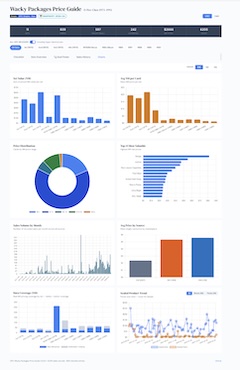
Everything on this page is written with as much confidence as the data supports. That's worth naming directly: the OPC Wacky Packages market is small enough that even the best records are thin.
Over years of tracking OPC sales across every set, condition, and format (singles, sealed packs, boxes, wrappers, uncut sheets), a clear pattern emerges: many specific combinations have only a handful of recent sales to anchor pricing to, and some have none at all. The vintage 1973 series trade more actively than the reruns. Sealed product surfaces rarely. Graded cards are a small subset. Across 11 sets and hundreds of individual titles, the data is deepest where collector interest is highest — and thin everywhere else.
What that means in practice is that individual prices sometimes move in ways that don't look rational. A recent example: a 1982 OPC album I bought two weeks ago for $120 US — shortly after, a bidding war on another listing drove an identical album to $360. The seller of that second listing told me five years ago he could have asked $500. Right now another one is listed at around $100 and has been sitting. Four very different numbers for the same item, within a short window, all "real" in the sense that someone either paid them or asked them.
None of this is unique to OPC — thin markets do this everywhere. But it's worth knowing as you think about what your cards are worth. Even a careful appraisal is a best-current-read, not a guarantee. For items with thin data, experience and feel end up carrying weight that in a deeper market would be carried by numbers. I'll be explicit in your appraisal about which items have strong data behind them and which are judgement calls.
Where to sell Wacky Packages
Different material sells best in different places. Here's the honest picture:
- Major auction houses (Heritage, Hake's, Mile High) are the best fit for high-value individual items — a graded 1973 card in PSA 7+, vintage sealed boxes, uncut sheets. Auction houses charge seller fees (typically 10–20%) but reach serious collectors with budgets. Minimum thresholds usually apply — they're not interested in common material.
- eBay works for complete sets, mid-tier singles, and sealed product in the hundreds-of-dollars range. Price based on sold listings, not active ones. Good photos and honest condition descriptions matter. Expect 13% in seller fees plus payment processing.
- Card shows and local sports card shops work for bulk material and face-to-face transactions. You'll typically get 30–60% of retail value, but it's fast and cash.
- Private sale to a specialist collector works well for specific niche items — a missing card from someone's set, a sealed pack from a favourite era. Often yields better prices than auction for the right buyer, but finding the right buyer is the challenge.
- Consignment at a specialist dealer is an option for larger collections you don't want to sell piece by piece. The dealer takes a percentage but handles the work.
The free appraisal is a good first step regardless of where you ultimately sell. Knowing what you have and what it's worth puts you in a position to choose the venue that makes sense.
What I buy (and what I don't)
Full disclosure: I'm a Canadian collector building my own OPC Wacky Packages collection. I'm not a dealer. Anything I buy goes into my permanent collection, not back onto the market. That's worth knowing, because it means a card I buy goes to a loved home — and it also means my interest is narrow and specific.
If you have something I'd want, I may make a fair offer after the appraisal. If not, I'll happily point you toward the best way to sell it elsewhere. Either way, the appraisal itself is genuine and independent of whether I end up buying anything.
What I'm looking for
- 1973 OPC singles I'm missing. Across all four 1973 series. The appraisal will flag these if you have them.
- 1973–1980 OPC sealed product. Packs, boxes, and wrappers from the vintage era.
- 1988 OPC red sealed box. Specifically the red variant — I don't need the yellow.
What I'm not looking for
- Complete sets from 1982, 1985, 1987, 1988, 1989, or 1992 — I have all of them already.
- Modern Wacky Packages (the post-2004 Topps ANS, Old School, and related series). Those are a separate market and outside what I do.
- American Topps material. I can tell you whether it's Topps or OPC, but valuing and buying Topps isn't my expertise.
If any of this sounds relevant to what you have, the free appraisal is the starting point. Nothing obligates you to sell to me or anyone else.
Common questions
Are my Wacky Packages worth anything?
Almost certainly yes — but usually not as much as people hope. Wacky Packages were printed in enormous quantities in the 1970s and trade in a small collector market with a few thousand active buyers worldwide. A typical collection from a shoebox or attic will have modest value, with occasional standouts. Specific valuable items exist, but they're the exception rather than the rule.
How do I tell if I have OPC or Topps Wacky Packages?
The surest way is to check the copyright line on the back or front of the sticker — look for "O-Pee-Chee," "Printed in Canada," or "O.P.C PTD. IN CANADA." Some OPC sets (1985 and the 1979/80 rerun) use stickers physically identical to Topps and can only be identified by the wrapper, which carries OPC branding and bilingual French markings. Other OPC sets have the OPC name right on the sticker itself. The Identify Your Cards page walks through every OPC set with images and identification details.
Should I get my Wacky Packages graded by PSA or CGC?
Only if the card is genuinely rare and in high grade. Grading costs roughly $15–$40 per card plus shipping, and is worth it when the graded result will meaningfully exceed raw value — typically on scarce 1973 cards that come back PSA 7 or higher. For common cards or mid-grade copies, grading usually costs more than it adds. The full reasoning is in the graded cards section above.
What's the most valuable OPC Wacky Package?
There's no single answer. The 1973 series (1st through 4th) are the most valuable era overall, with the 2nd Series being the toughest set to complete. Specific high-grade graded cards, scarce back variants, and sealed vintage product command the highest individual prices. But "valuable" in the OPC market still means tens to low hundreds of dollars for most items, not thousands.
Why does eBay show Wacky Packages selling for thousands of dollars?
eBay shows both active listings (asking prices) and sold listings (what actually changed hands). Active listings can sit unsold for months or years at hopeful prices. The real market is what sold — use eBay's "Sold Items" filter to see actual transactions. For many OPC items, the sold prices are a fraction of the active listing prices.
Are 1980s OPC Wacky Packages valuable?
Generally no. The 1985, 1987, 1988, and 1989 OPC releases are widely available with modest per-card values — typically a dollar or two per sticker in good condition. Sealed product from this era has some scarcity appeal but doesn't command the prices people often hope for. The 1982 Album set is harder to find than Topps but similarly modest in value. The Age doesn't equal value section above explains why.
Is it true that Garbage Pail Kids came out of Wacky Packages?
Yes — the same team at Topps that produced Wacky Packages went on to create Garbage Pail Kids in 1985, with Art Spiegelman (who drew the original 1967 Wacky Packages) involved in both. The two are related in lineage, but they're distinct collectible markets with different collectors, different pricing, and different sets. GetWacky.ca focuses on Wacky Packages — specifically the Canadian OPC releases. I don't appraise or value Garbage Pail Kids.
Do you buy Wacky Packages collections?
Sometimes, and only for my personal collection. I buy specific OPC cards I'm missing, vintage sealed product from 1973–1980, and the 1988 OPC red sealed box. I don't buy modern Wacky Packages, Topps material, Garbage Pail Kids, or sets I already have. Full details are in the What I buy section above. The appraisal itself is independent of whether I buy anything.
What if my cards are Topps, not OPC?
I'll tell you they're Topps, but I'm not the right person to appraise them. The Topps market is larger and has its own specialists. Sites like wackypackages.com (Greg Grant's long-running reference) are better resources for Topps valuation, and PSA's price guide covers the major Topps series.
Ready for a real answer?
Send me some photos and I'll tell you exactly what you have and what it's worth. Free, honest, no obligation.
Request a Free AppraisalLast updated: April 2026