How to Identify Your O-Pee-Chee Wacky Packages
Not sure if your stickers are Canadian or American? This guide covers all 11 OPC sets with identification tips and complete checklists.
General Identification Tips
The quickest way to identify most OPC Wacky Packages is to check the fine print on the sticker itself. This works for the 1973 series, the 1982 album stickers, the late-1980s reruns, and the 1992 series — but not for every set (see below).
Other clues include bilingual English/French text on the packaging (a requirement for Canadian products), different cardstock that may feel slightly different, and slightly rougher or looser edges from how OPC's cutting was done — though this alone isn't definitive. If your stickers are noticeably smaller than standard (about 2⅛" × 3" instead of 2½" × 3½"), you likely have 1982 OPC Album Stickers.
1st Series OPC — 25 Stickers
The first O-Pee-Chee Wacky Packages set, produced for the Canadian market as a reissue of the Topps 1st Series. The OPC version has 25 titles, compared to 30 in the Topps version — several Topps titles didn't make it into the Canadian release. Two back variations exist: tan backs and white backs, with white backs being scarcer. The set is rounded out by 9 puzzle/checklist cards whose fronts assemble into a Gadzooka image. The checklist cards themselves come in two back versions (dark and light), so collectors building a master set track both.
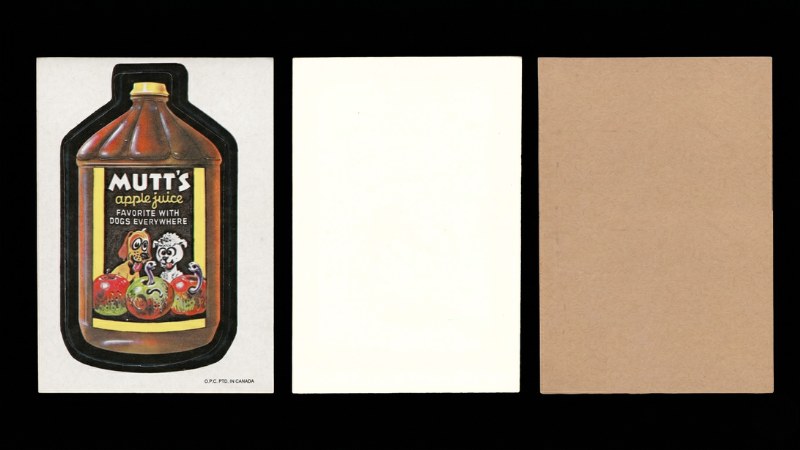
How to Identify
Look for "O.P.C. PTD. IN CANADA" in the fine print on the front. The back colour is also a key identifier — tan backs are the standard variant, while white backs (sometimes called glossy backs) are rarer. OPC versions were printed on slightly different cardstock than the American Topps release.
📦 Have a 1973 OPC pack or box? See 1973 Series Packs & Boxes for identification details.
2nd Series OPC — 25 Stickers
A Canadian reissue of the Topps 2nd Series. The OPC version has 25 titles, compared to 33 in the Topps version — several Topps titles didn't make it into the Canadian release. Tan backs only. The set also includes 9 puzzle/checklist cards whose fronts assemble into a Gadzooka Sugarmess image. This is widely considered the toughest OPC set to complete.
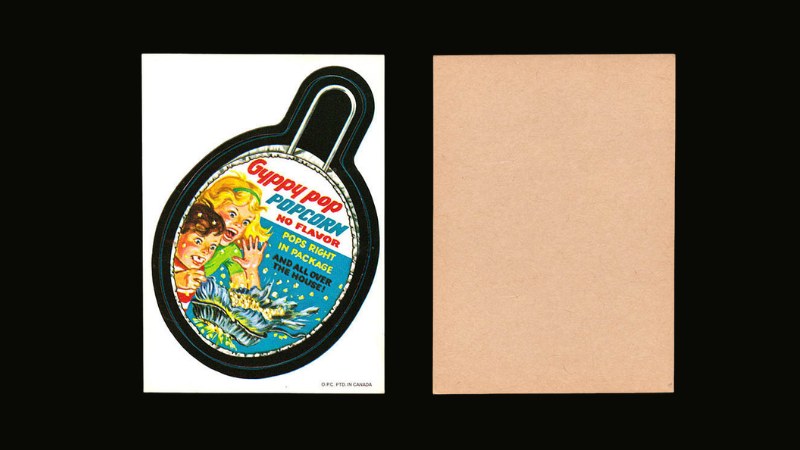
How to Identify
Tan backs only — no white backs in this series. Look for "O.P.C. PTD. IN CANADA" in the fine print on the front. See the complete checklist below for what's included.
📦 Have a 1973 OPC pack or box? See 1973 Series Packs & Boxes for identification details.
3rd Series OPC — 24 Stickers
A Canadian reissue of the Topps 3rd Series. The OPC version has 24 titles, compared to 30 in the Topps version — several Topps titles didn't make it into the Canadian release. Like the 1st Series, it has both tan and white backs — but here the roles are reversed: tan backs are extremely rare, while white backs are the standard. The set also includes 9 puzzle/checklist cards whose fronts assemble into a Beanball image, with the checklist cards themselves coming in two back versions (dark and light).
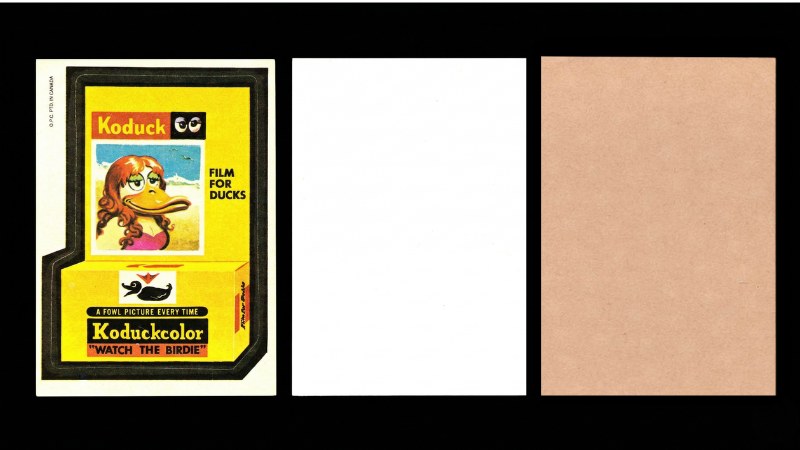
How to Identify
Look for "O.P.C. PTD. IN CANADA" in the fine print on the front. White backs are standard for this series; tan backs are very rare.
📦 Have a 1973 OPC pack or box? See 1973 Series Packs & Boxes for identification details.
4th Series OPC — 19 Stickers
The smallest OPC Wacky Packages set. A Canadian reissue of the Topps 4th Series — the OPC version has just 19 titles, compared to 32 in the Topps version, making it the most trimmed-down of the 1973 sets. Tan backs only. The set also includes 9 puzzle/checklist cards whose fronts assemble into a Wormy Packages image.
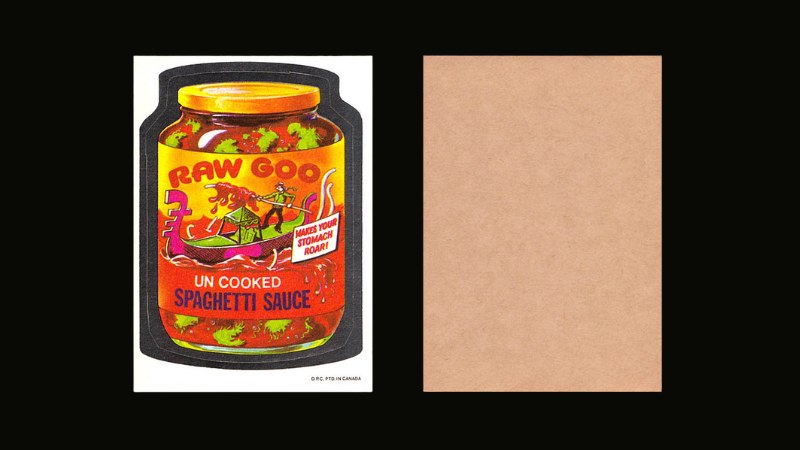
How to Identify
Tan backs only. Look for "O.P.C. PTD. IN CANADA" in the fine print on the front.
📦 Have a 1973 OPC pack or box? See 1973 Series Packs & Boxes for identification details — the 4th Series has the most documented sealed product, including the "2nd Series" box mystery.
1979/1980 Rerun Series — 264 Cards
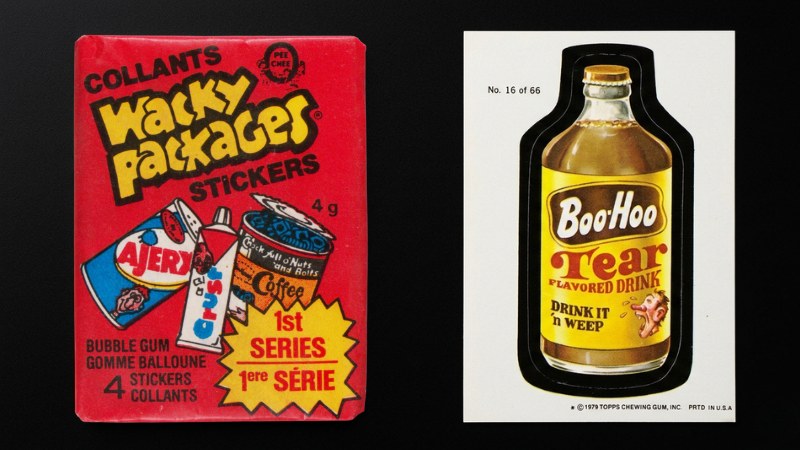
This large rerun set reprints earlier Topps Wacky Packages designs. The stickers themselves are physically identical to their Topps counterparts — the only difference is the OPC packaging (wrappers and boxes).
How to Identify
The stickers look identical to Topps versions and even carry the Topps copyright. Identification comes entirely from the packaging — look for the O-Pee-Chee logo, bilingual French text like "COLLANTS" (stickers) and "GOMME BALLOUNE" (bubble gum), and "SÉRIE" (series) markings on the wrapper or box. If you have loose stickers without packaging, they cannot be distinguished from Topps.
Puzzle & Checklist Backs
Each of the four series in this 264-card set has its own puzzle back. Series 1 assembles a Gadzooka image, Series 2 assembles Wormy Packages, Series 3 assembles Beastball, and Series 4 assembles Real Garbage Can-Dy. Each series also includes 12 checklist cards mixed in with the puzzle pieces.
Series 3 has one known legitimate front variation: card #141, Heavy Trash Bags, exists with and without a tagline reading "WATCH WHILE YOUR GARBAGE MAN STRUGGLES." The version "without" actually shows a faint ghost image of the tagline — a production artifact rather than a true clean print.
📦 Have a 1979/80 OPC pack or box? See 1979/80 Rerun Packs & Boxes — three distinct OPC packaging releases covered, each with different boxes and pack contents.
1982 OPC Album Stickers — 120 Stickers
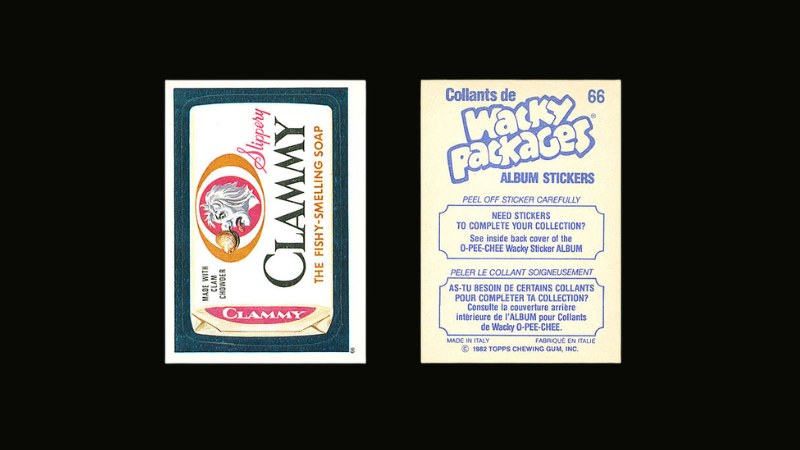
A smaller-format sticker set designed to be placed in a companion album. The OPC version has 120 titles. The stickers measure 2⅛" × 3" — noticeably smaller than standard Wacky Packages, which are 2½" × 3½". Two titles were swapped from the Topps version: #50 Pounds Cream became Clank Candy, and #66 Petley Flea Bags became Clammy Soap. Unlike loose stickers from the 1979/80 Rerun and 1985 sets, a loose 1982 OPC sticker can be identified on its own — the back has bilingual French and English text and references the "O-PEE-CHEE Wacky Sticker ALBUM" by name.
Two back variants exist across the set, both bilingual and both referencing the OPC album. One carries a "starter" message ("To collect your stickers... ask your dealer for the O-PEE-CHEE Wacky Sticker ALBUM"), and the other carries a "completer" message ("Need stickers to complete your collection? See inside back cover of the O-PEE-CHEE Wacky Sticker ALBUM"). Both variants also display "FABRIQUÉ EN ITALIE / MADE IN ITALY" — these stickers were printed in Italy, unusual for the Wacky Packages line.
How to Identify
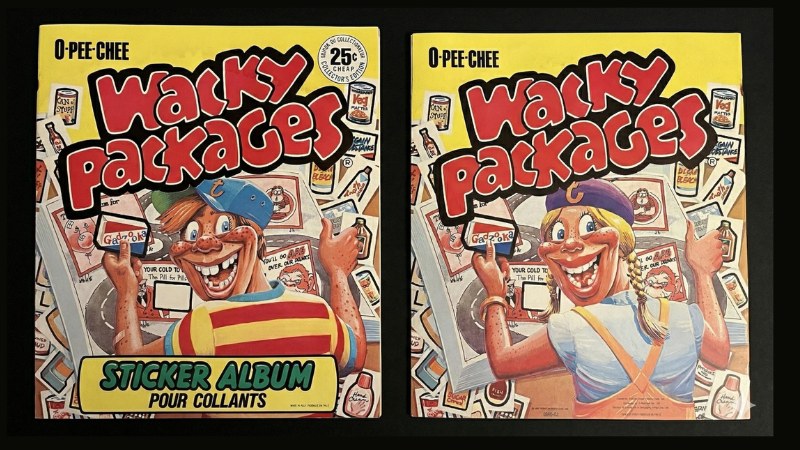
The smaller size is the immediate giveaway — if your stickers are noticeably smaller than other Wacky Packages, you likely have the 1982 Album Series. To confirm OPC vs Topps origin, flip a sticker over: the OPC backs have bilingual French and English text and reference the "O-PEE-CHEE Wacky Sticker ALBUM" by name. The accompanying album is a collectible in its own right, even when empty — look for the "O·PEE·CHEE" branding on the cover.
📦 Have a 1982 OPC pack or album? See 1982 Album Sticker Packs for packaging details.
1985 OPC Series — 44 Cards
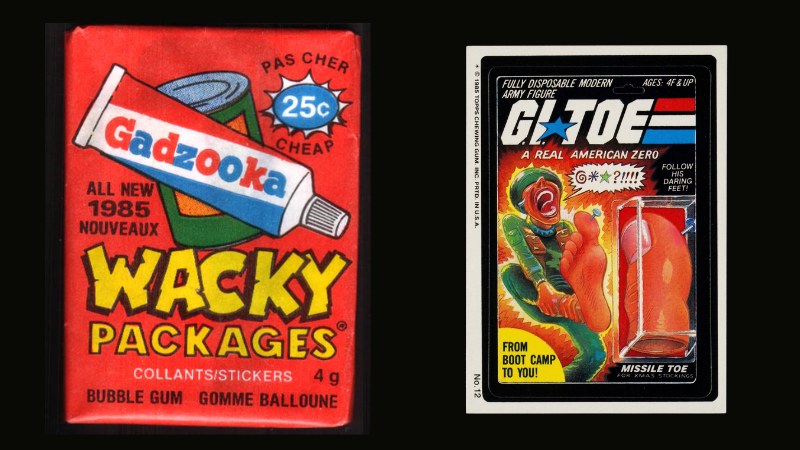
Like the 1979/1980 Rerun, the 1985 OPC stickers are physically identical to the Topps release — the same cards, same print. Only the packaging identifies them as OPC.
How to Identify
The stickers look identical to Topps versions and even carry the Topps copyright. Identification comes entirely from the packaging — look for the O-Pee-Chee logo, bilingual French text like "COLLANTS" (stickers), "GOMME BALLOUNE" (bubble gum), and "PAS CHER" (cheap), and the "ALL NEW 1985 / NOUVEAUX" markings on the wrapper or box. If you have loose stickers without packaging, they cannot be distinguished from Topps.
Puzzle & Checklist Backs
The 44 cards in this set split between two puzzles that you can tell apart at a glance by the border colour. Red-border cards (21 of them) assemble into Batzooka. Blue-border cards (17 of them) assemble into Beastball. Three cards are checklists, and a couple of cards show the completed puzzle preview.
📦 Have a 1985 OPC pack or box? Since loose stickers can't be identified, the wrapper is the only way to confirm OPC origin — see 1985 Series Packs for what to look for.
1987 OPC Rerun — 66 Cards
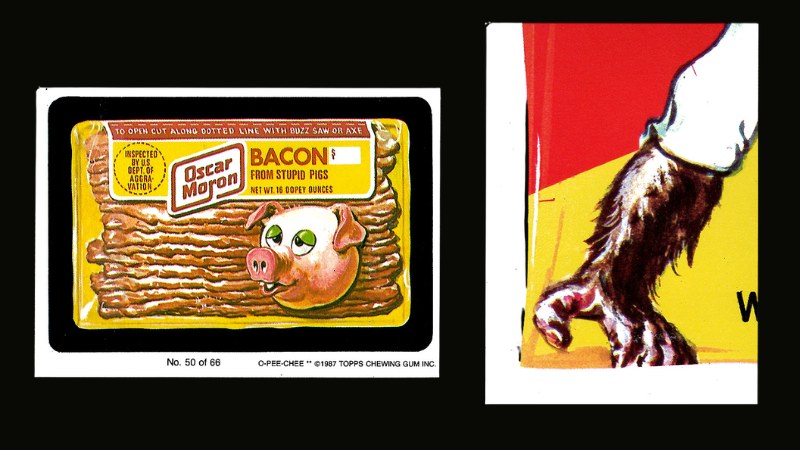
The first of three Canada-only rerun sets from the late 1980s. These sticker compilations reprint earlier 1970s Wacky Packages designs but are exclusive to Canada — Topps did not produce an equivalent rerun set. Unlike the 1979/80 and 1985 reruns, the 1987 stickers carry "O-PEE-CHEE" right in the copyright line, so a loose sticker can be identified on its own.
How to Identify
Look for "O-PEE-CHEE" in the copyright line on the sticker — in 1987 it appears alongside the Topps copyright (e.g., "O-PEE-CHEE ** ©1987 TOPPS CHEWING GUM INC"). The sticker artwork is reprinted from 1970s Topps originals, but the compilation and packaging are unique to Canada.
One quirk of this set: four titles (Cents, Creep, Mashbox, and Smartz 2 in 1) each appear twice under different card numbers. If you see the same sticker listed twice in the checklist, that's why — not a typo.
Puzzle & Checklist Backs
The puzzle backs in this set assemble into a Beastball image — OPC reused this puzzle concept across several eras, with small art and tagline differences between the 1975, 1985 and 1987 versions.
📦 Have a 1987 OPC pack or box? See 1987–89 Rerun Packs for packaging details.
1988 OPC Rerun — 66 Cards
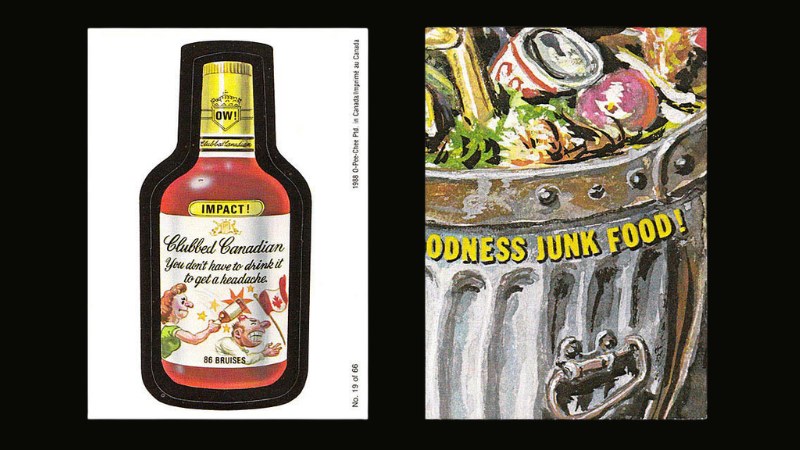
The second Canada-only rerun, compiling another selection of 1970s Wacky Packages designs for the Canadian market. No back variations or short prints in this set. Like the 1987 set, the 1988 stickers carry the OPC name on the front, so loose stickers can be identified on their own.
How to Identify
Look for "1988 O-Pee-Chee Ptd. in Canada / Imprimé au Canada" on the sticker — by 1988, OPC had dropped the Topps copyright line entirely and printed bilingual French/English credit on the front. The artwork still reprints 1970s Topps originals, but the compilation and packaging are exclusive to Canada.
Puzzle & Checklist Backs
The puzzle backs assemble into Real Garbage Can-Dy — the same puzzle title that appeared across the 1979/80 Rerun Series 4.
📦 Have a 1988 OPC pack? See 1987–89 Rerun Packs — the 1988 packs are red, which is the easiest way to tell them apart from 1989 packs.
1989 OPC Rerun — 62 Stickers (66 Cards with Back Variants)
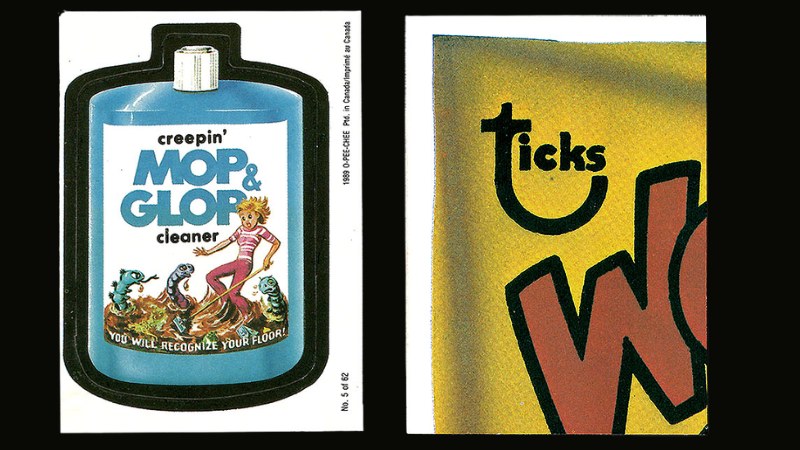
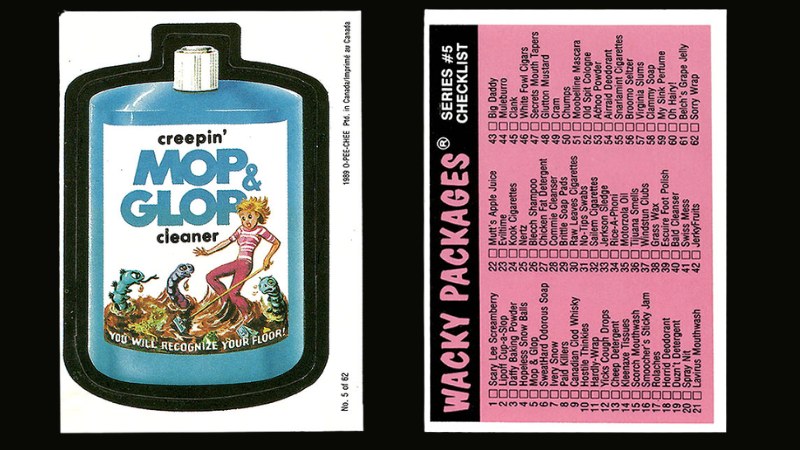
The third and final Canada-only rerun. The set has 62 sticker titles. Like 1988, the 1989 stickers carry bilingual "O-Pee-Chee Ptd. in Canada / Imprimé au Canada" credit on the front, so loose stickers can be identified on their own. Three titles — Mop & Glop, Scorch, and Blecch — exist with two different back designs (a checklist back and a puzzle-piece back), and Eviltime exists with two different die-cut variations. Master-set collectors track all 66 entries; most collectors stop at the 62 titles.
How to Identify
Look for "1989 O-Pee-Chee Ptd. in Canada / Imprimé au Canada" on the sticker. Heads up on the dating: the box for this set is labelled "1988" even though the stickers are dated 1989 — this is the official 1989 series. (See the Packs & Boxes section for how to tell the actual 1988 set from this one.)
Puzzle & Checklist Backs
The puzzle backs assemble into Wormy Packages. OPC had used this puzzle title twice before — as the 1973 4th Series puzzle and the 1979/80 Rerun Series 2 puzzle.
📦 Have a 1989 OPC pack or box? See 1987–89 Rerun Packs — the 1989 set's box is confusingly labelled "1988," and the pack itself doesn't print a year (it just says "NEW SERIES / NOUVEAU"), making the disambiguation tricky.
1992 OPC Series — 48 Stickers (66 Cards with Back Variants)
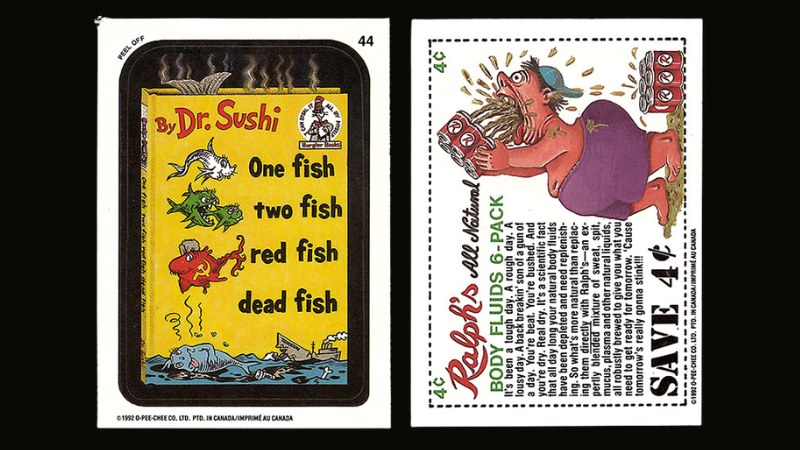
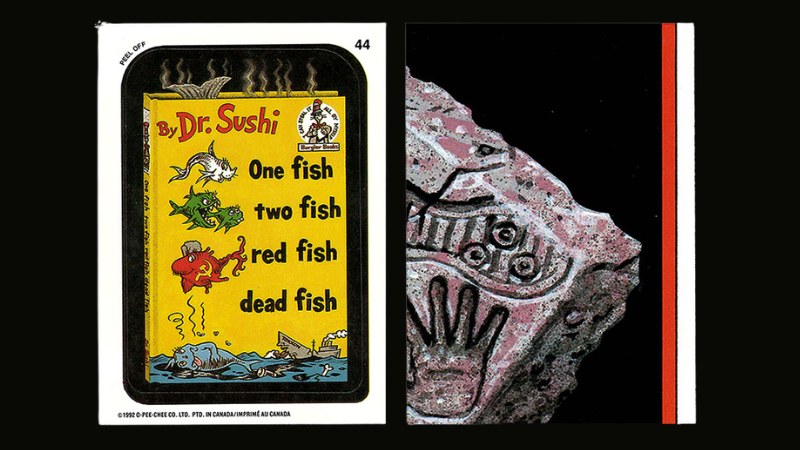
The final OPC Wacky Packages set, and the Canadian release of the 1991 Topps series. The OPC version has 48 unique sticker titles — eight of the 56 Topps titles didn't make it into the Canadian release. 18 of those 48 titles exist with two different back designs, bringing the master checklist to 66 cards. The back types include coupons, puzzle pieces, and a completed puzzle reveal. Like the 1988 and 1989 sets, 1992 OPC stickers carry bilingual O-Pee-Chee credit on the front, so loose stickers can be identified on their own.
How to Identify
Look for "©1992 O-PEE-CHEE CO. LTD. PTD. IN CANADA / IMPRIMÉ AU CANADA" on the sticker. The back variants (coupon, puzzle piece, completed puzzle) affect completeness for set builders but are usually not a major factor in value. Packs are yellow and contain 5 stickers each.
Puzzle & Checklist Backs
The puzzle backs assemble into a Badzooka image — a new puzzle exclusive to the 1992 set.
📦 Have a 1992 OPC pack? See 1992 Series Packs — the 1992 wax wrappers are yellow.
Identifying OPC Wax Packs & Boxes
If you've found sealed wax packs or display boxes, that's exciting — sealed OPC Wacky Packages product is scarce and always in demand. The 1973 series gets the most attention here because it's both the most sought-after era and the trickiest to identify, but every era has packaging worth knowing about.
A few things to know upfront. Wax packs were the small individual packages sold from store counters, each containing a handful of stickers and (usually) a stick of bubble gum. Display boxes held multiple packs for retail sale — typically 36 packs per OPC box, vs 48 in the equivalent Topps box. An OPC display box is distinctly branded with the O-Pee-Chee name and logo and almost always carries bilingual French text. Some boxes have notable quirks worth knowing: the 1973 4th Series boxes are mislabelled "2nd Series," and the 1989 Rerun boxes are labelled "NEW 1988" even though the stickers inside are dated 1989. Both empty and full boxes are uncommon, with full boxes being more valuable, but some are rarer than others. As far as we know, only the 1992 OPC display boxes shipped with a branded outer plastic wrapper — earlier years either had a piece of tape holding the box closed or nothing at all, so "factory sealed box" means something slightly different in each era.
Don't open sealed packs or boxes — even to check the cards inside. The value of sealed product comes from it being unopened. Two cautions worth knowing:
Wax can be tampered with. Wax wrappers can be carefully opened, contents removed or swapped, and re-sealed. "Sealed" doesn't always mean "untouched," especially for vintage wax product from unknown sources.
Sealed value tracks scarcity, not the seal itself. A sealed pack from a scarce vintage set commands a premium because the cards inside are valuable. Sealed product from a more recent or common set doesn't get the same uplift. Be skeptical of inflated prices on sealed material from sets where loose stickers are easy to find.
If you're not sure what you have, photograph the wrapper from all angles and include it in your appraisal request.
1973 Series Packs & Boxes
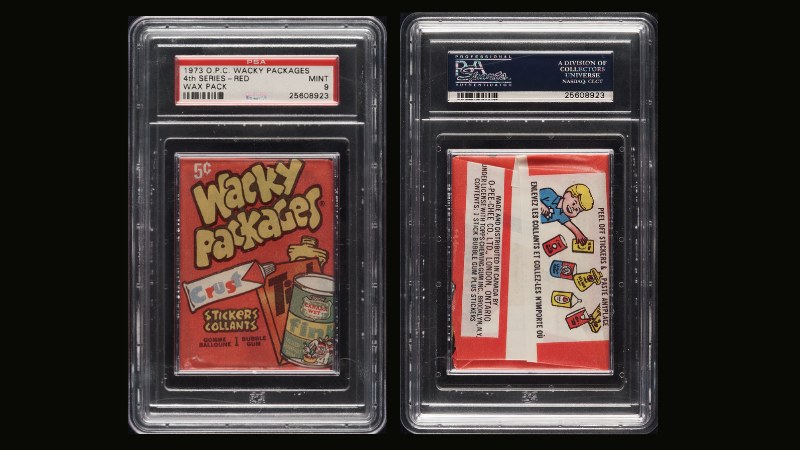
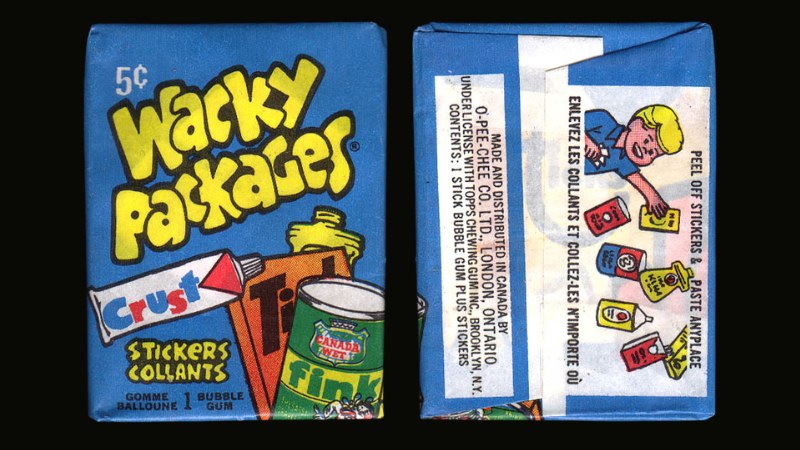
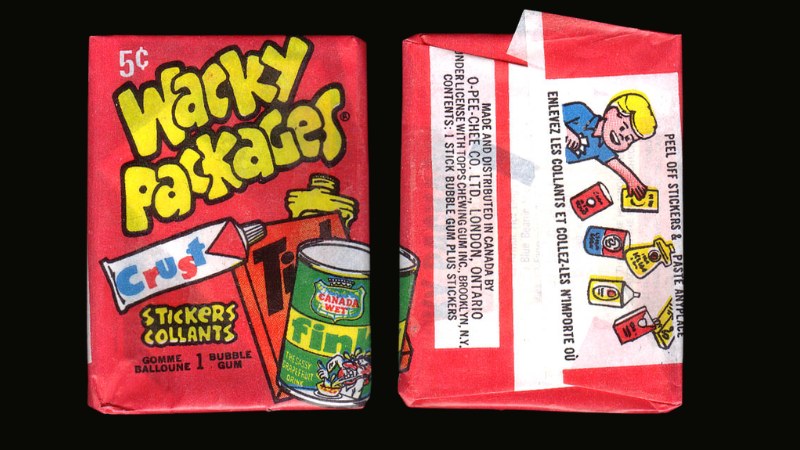
The earliest OPC Wacky Packages packs. Wax wrappers carry the O-Pee-Chee logo with bilingual text — "Wacky Packages STICKERS / COLLANTS" on the front and "MADE AND DISTRIBUTED IN CANADA BY O-PEE-CHEE CO. LTD., LONDON, ONTARIO" along with the French equivalent on the back. Each pack contained stickers and a stick of bubble gum.
The 4th Series is the best-documented for sealed product. Two pack colour variants exist: red wax packs and blue wax packs. The pack design is identical between the two — only the background colour differs.
The "2nd Series" Box Mystery
1973 OPC display boxes have a quirk that confuses everyone who encounters them. Boxes labelled "2nd Series" on the front have, in every documented example, contained 4th Series stickers. Whether genuine 2nd Series boxes ever existed is an open question — none have surfaced. If you have a "2nd Series" labelled OPC box, the contents are almost certainly 4th Series.
For the 4th Series specifically, the closed boxes have a yellow colour band that signals red wax packs inside. Without opening the box, that yellow band is the only outside indicator of which pack colour variant the box holds.
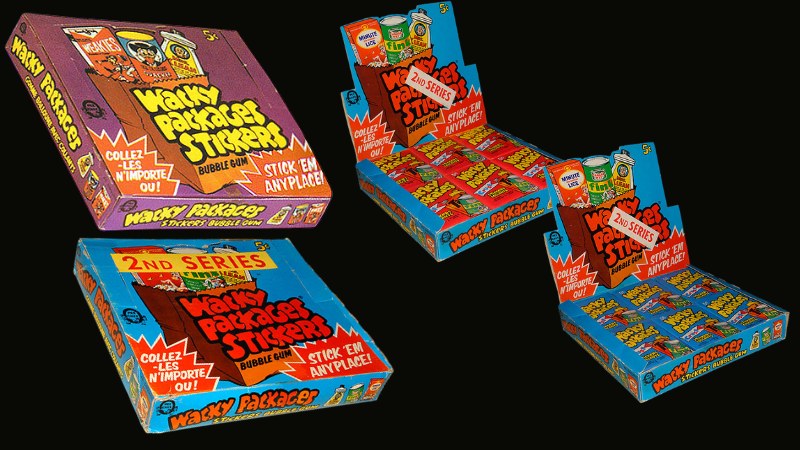
Sealed 1973 OPC product is genuinely scarce and rarely surfaces at auction. If you have a 1973 pack or box of any kind, it's worth careful documentation before doing anything with it — photograph all sides of the wrapper or box, don't open anything, and reach out for an appraisal.
1979/80 Rerun Packs & Boxes
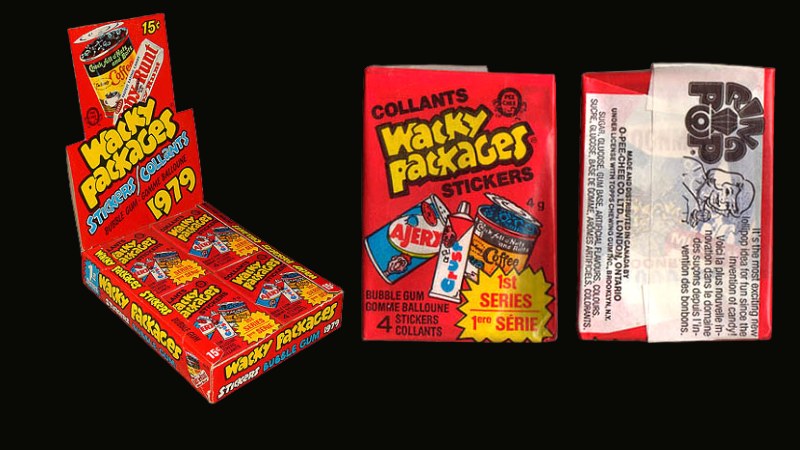
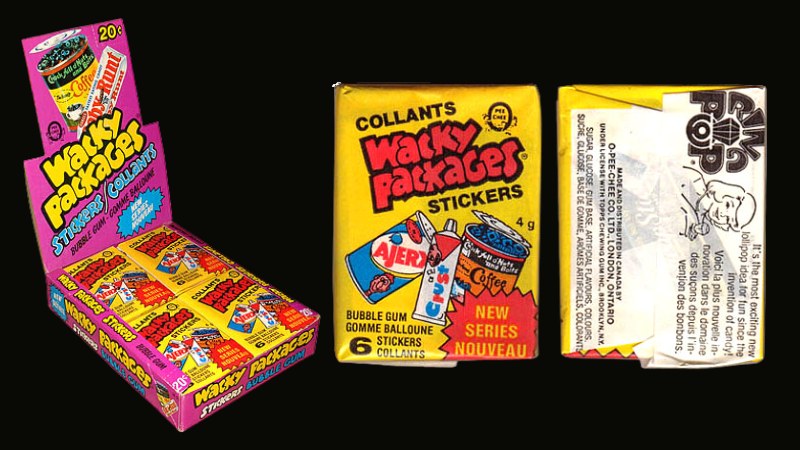
The 1979/80 Rerun was distributed in three distinct OPC packaging releases over two years, each with a different box, pack, and contents. The wrapper is the entire identification story for this era — the stickers inside are physically identical to Topps reruns and even carry the Topps copyright. All three releases share the same OPC bilingual back text and Ring Pop promotional ad on the wrapper (a Super Bazooka ad variant also exists for the 1st Series wrapper).
New Series (1979) — 1st Rerun
The first 1979 OPC release. Red display box marked "1979" with a 15¢ price point. Red wax wrapper labelled "1st SERIES / 1ere SÉRIE". Each pack contained 4 stickers plus a piece of bubble gum. Covers cards #1–66 of the 1979/80 rerun checklist.
2nd/3rd Combined (1979/80) — 2nd Rerun
The second OPC release combined the 2nd and 3rd Topps rerun series into a single product. Pink/magenta display box at a 20¢ price point. Yellow wax wrapper labelled "NEW SERIES / NOUVEAU" (no series number). Each pack contained 6 stickers plus gum. Covers cards #67–198 of the 1979/80 rerun checklist.
4th Series (1980) — 3rd Rerun
The third and final 1980 OPC release. Yellow display box at a 25¢ price point. Red wax wrapper also labelled "NEW SERIES / NOUVEAU" like the 2nd/3rd release. Each pack contained 8 stickers plus gum. Covers cards #199–264 of the 1979/80 rerun checklist.
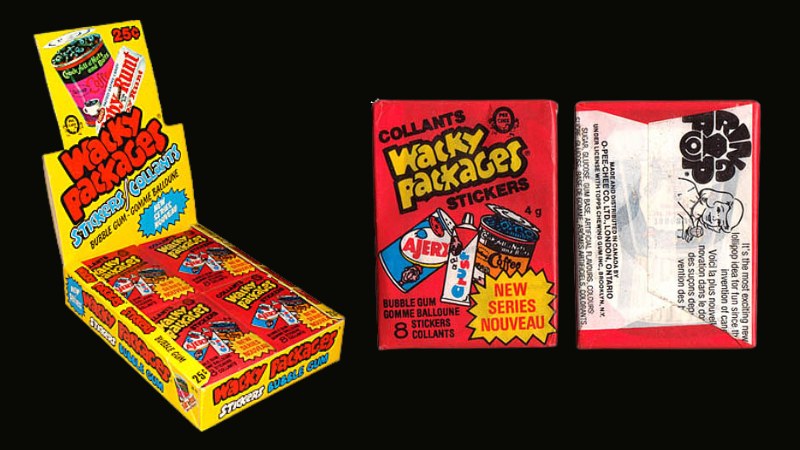
Quick reference for telling the three releases apart at a glance: 15¢ red box / 4 stickers = 1st Series 1979. 20¢ pink box / 6 stickers = 2nd/3rd Combined 1979/80. 25¢ yellow box / 8 stickers = 4th Series 1980. The pack count and price are usually the easiest way to identify which release a sealed pack came from without opening it.
1982 Album Sticker Packs
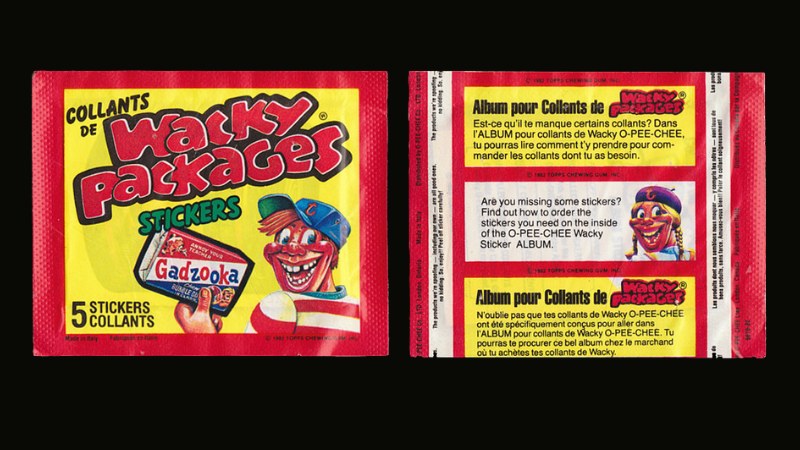
Smaller-format packaging to match the smaller album stickers — these packs are a noticeably different shape from the standard wax packs of the era. Red wax wrapper with the Wacky Packages logo, bilingual "STICKERS / COLLANTS" branding, and "5 STICKERS / COLLANTS" indicating the pack contents. The wrapper is marked "Made in Italy / Fabriqué en Italie" — these were printed in Italy along with the stickers themselves. Like the 1982 stickers, the wrapper carries the Topps copyright but the bilingual French and OPC album references are the OPC tells.
1985 Series Packs
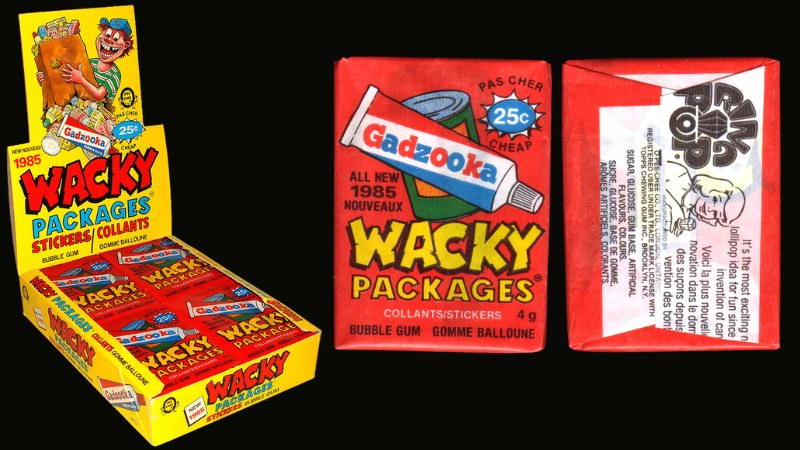
Like the 1979/80 Rerun, the wrapper is the only identification — the stickers inside are identical to the Topps release. Red wax wrapper with the Gadzooka tube graphic and "ALL NEW 1985 / NOUVEAUX" text. Look for the OPC bilingual markers ("COLLANTS / STICKERS", "GOMME BALLOUNE / BUBBLE GUM", "PAS CHER / CHEAP") on the wrapper. The display box is yellow with "25¢" and "1985" prominently displayed.
One useful detail for distinguishing OPC from Topps boxes: the OPC box contains 36 packs, while the Topps box contains 48 packs. If you have a sealed box and can read the pack count, that's a quick differentiator. The 1985 OPC release also appears to have had a fairly limited Canadian distribution — sealed product surfaces less often than the equivalent Topps material.
1987, 1988, and 1989 Rerun Packs
Canada-only releases — there are no Topps equivalents for these specific rerun compilations. The wrappers are distinctly OPC with bilingual text. Each year has its own pack and box design. The 1989 set is the source of the most confusion: its display box is labelled "NEW 1988" even though the stickers inside are dated 1989, and the 1989 wax pack design is the only one in this trio that doesn't print a year on the wrapper.
The disambiguation rule: if the pack itself has a year printed on it, that's the year of the set. If the pack only says "NEW SERIES" with no year, it's the 1989 set with the misleading "1988" box label.
1987 Rerun
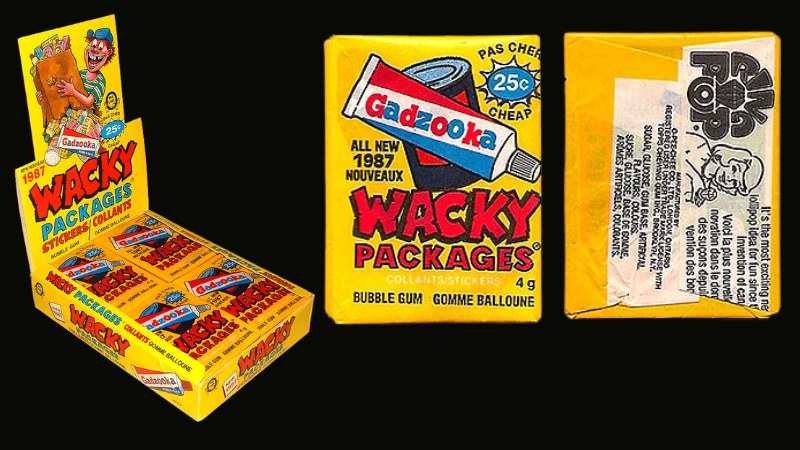
Yellow wax pack with "ALL NEW 1987 / NOUVEAUX". Yellow display box marked "1987".
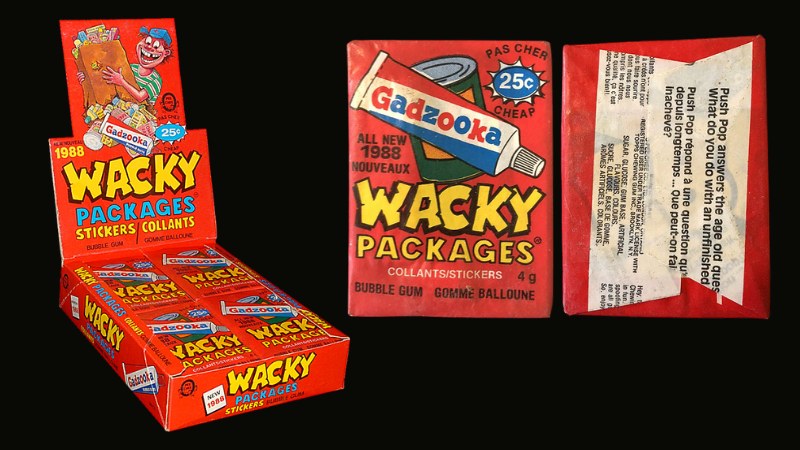
1988 Rerun
Red wax pack with "ALL NEW 1988 / NOUVEAUX". Red display box marked "1988".
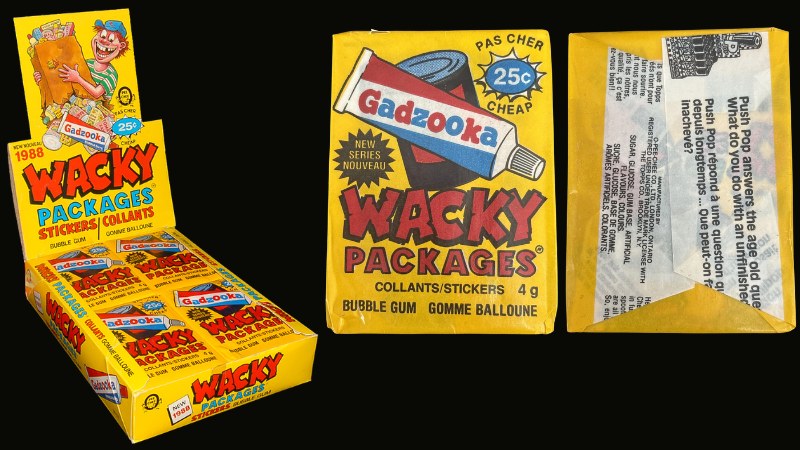
1989 Rerun
Yellow wax pack with only "NEW SERIES / NOUVEAU" — no year on the pack at all. Display box mislabelled "NEW 1988." Despite the box label, this is the official 1989 series — the stickers inside are dated 1989. The combination of "NEW SERIES" pack (no year) plus "1988" box label is the only way to identify a sealed 1989 release.
1992 Series Packs
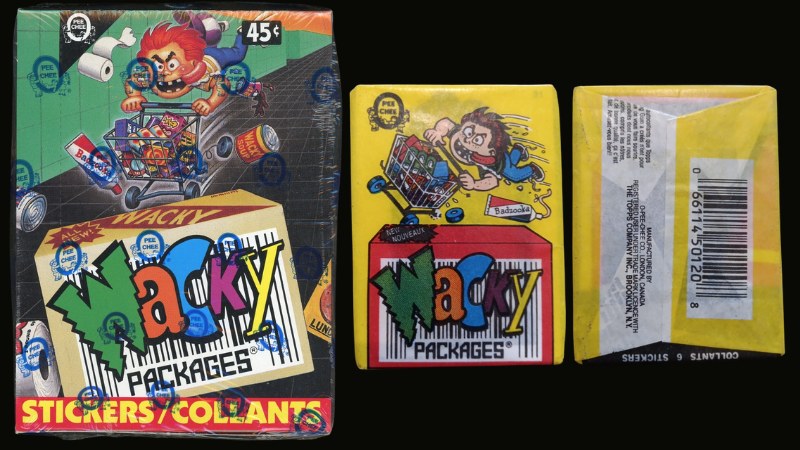
The final OPC Wacky Packages release, and visually distinct from everything that came before. Yellow wax wrapper with the Badzooka cement gum graphic and "STICKERS / COLLANTS" branding. The display box is decorated with the colourful Wacky Packages parody motif, marked "45¢". Unlike earlier packs, the 1992 series did not include bubble gum — but the wax wrapper can still leave residue on the cards inside.
The 1992 packs also carry a UPC barcode on the wrapper, a clear marker of more modern retail packaging. None of the earlier OPC Wacky Packages releases had barcodes. If you see a barcode on a Wacky Packages wrapper, you're looking at the 1992 series. The 1992 boxes are also the only OPC Wacky Packages display boxes known to have shipped with a branded outer plastic wrapper — earlier years used tape or nothing at all.
Uncut Sheets
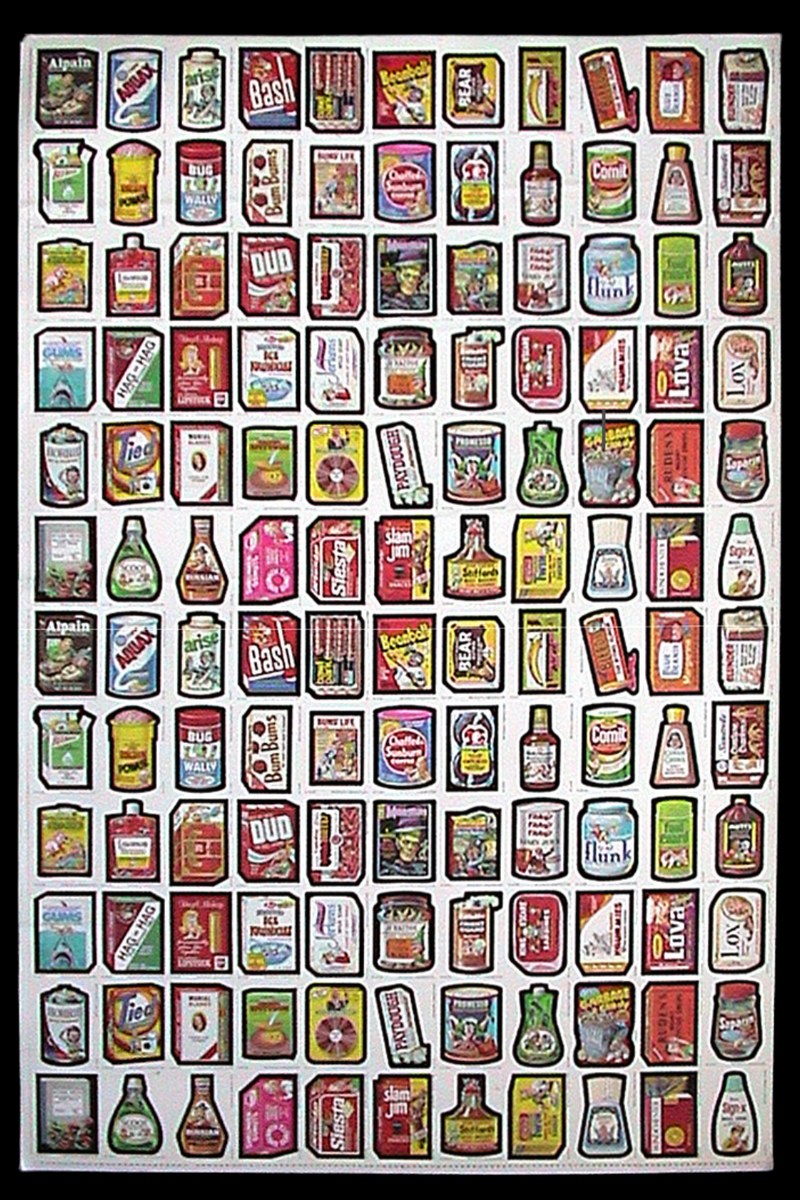
Before individual stickers were cut and packaged, they existed as large printed sheets — rows and columns of stickers on a single piece of cardstock. Occasionally these uncut sheets survived the production process without being cut apart, either as factory leftovers or pulled from the production line as a curiosity.
OPC uncut sheets are extremely rare. Most collectors have never seen one in person, and only a handful are documented across all eras. The late-1980s rerun sheets each contained 132 stickers — two complete 66-card sets stacked on a single sheet — and surface occasionally. Vintage 1973 sheets are dramatically scarcer.
What sheets tell us
An uncut sheet is essentially a snapshot of how Wacky Packages were actually made. You're looking at the same print run that produced thousands of single stickers, except this one never got fed through the cutter. The grid layout, registration marks, and title arrangement are all production decisions frozen in place.
Sheets also reveal something you can't see from singles alone: which titles were intentionally short-printed. If a sheet shows certain titles appearing more often than others, that's the production team deliberately printing some titles less frequently — which has knock-on effects for how scarce those titles end up in the wild. It's the kind of detail that's almost impossible to confirm without seeing the sheet itself.
Storing an uncut sheet
Storage is one reason intact sheets are even scarcer than the production numbers would suggest. Sheets are large — much bigger than any individual sticker — and printed on cardstock that wants to curl. There's no standard storage solution: no slab fits them, no toploader is the right size, no album page accommodates them. Most sheets that have survived have been folded, rolled, or stored flat under heavy items, and any of those introduces condition issues.
The major grading companies (PSA, CGC, SGC, KSA) don't typically slab uncut sheets either — they're outside the standard slab dimensions. Some graders offer authentication-only services or oversized encapsulation, but it's specialty work and uncommon. This means there's no standard grade-based pricing for sheets the way there is for singles, and authentication leans more on careful photos and provenance than on third-party slabs.
Don't cut a sheet apart to make singles. The whole point of a sheet is that it's one of very few intact production artifacts left. Singles already exist in much greater numbers; sheets don't.
How to Tell It's Real
The simplest test: a real production sheet should look exactly like the singles, just multiplied. Same artwork, same fine-print copyright in the same place on the front, same back design. If anything looks different from how the individual stickers look, it's probably not a production sheet.
- Printed on actual card stock (the same material as individual stickers), not poster paper or glossy print stock
- Both front and back are printed — flip it over and you'll see the same back design used on the regular cards from that set
- The fine-print copyright on the front of each sticker matches what you'd see on a single from that set
- Multiple different titles arranged in a grid pattern, with cutting guide marks and registration marks visible along the edges or between stickers
- If a sheet has artwork that doesn't appear on any known single, or copyright text that doesn't match the production stickers, it's almost certainly a reproduction or proof — not a production sheet
Not sure what you have?
Send me some photos and I'll identify everything for you — it's part of the free appraisal.
Request a Free Appraisal